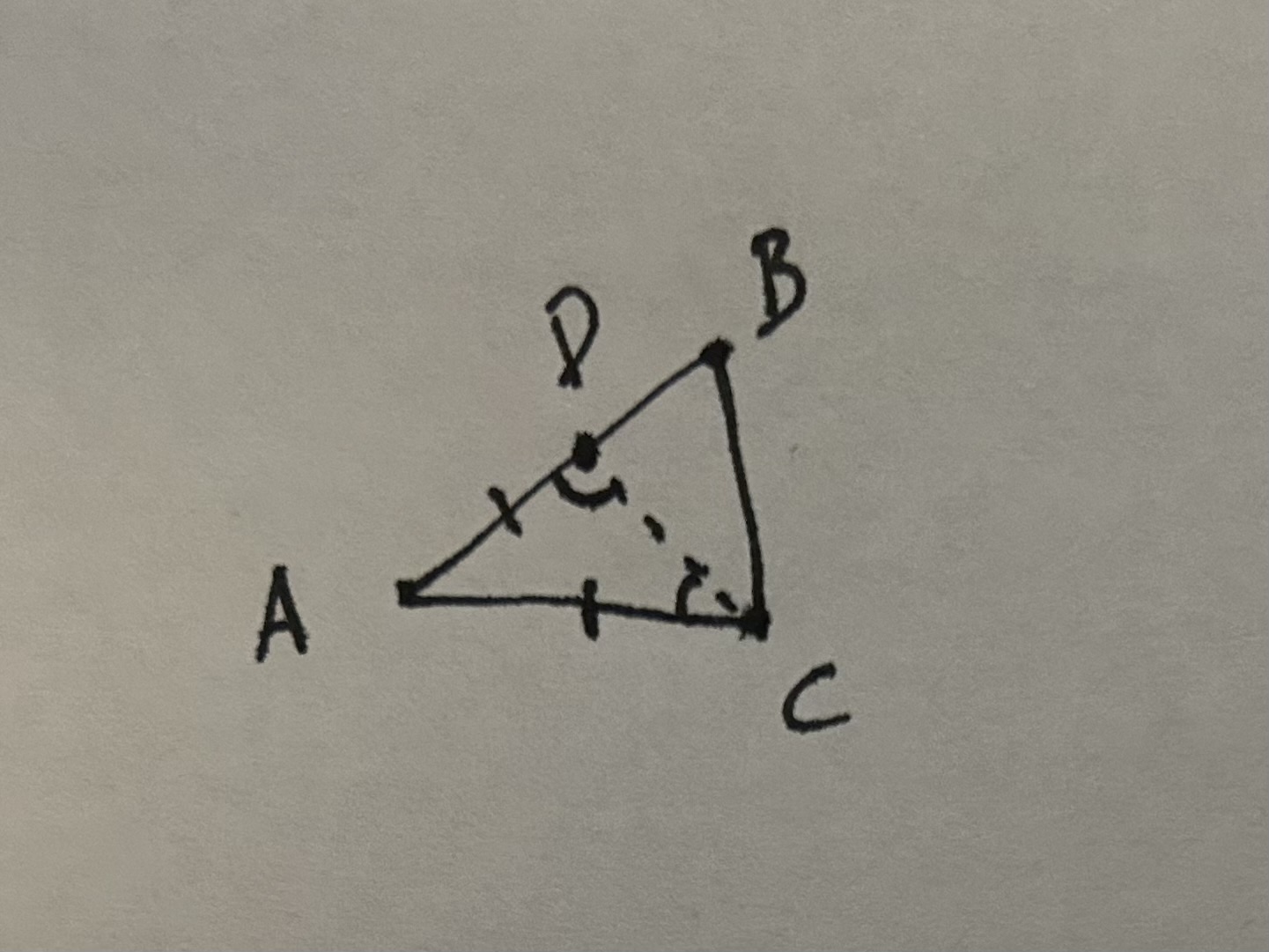
Section 2.1 Triangles

Subsection 2.1.1 Basic Triangle Theorems

Note all theorems in this section can and should be proved without using the parallel postulate.

Definition 2.1.1 Vertical Angles.

The opposing angles formed by the intersection of two lines are called vertical angles.

Definition 2.1.2 Congruent Angles.

Two angles are congruent (\(\angle ABC \cong \angle DEF\)) if and only if their measures are equal (\(m\angle ABC = m\angle DEF\)).

Proof.

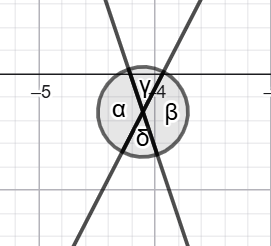
Image required for the proof of Theorem 2-1-3.
Take the figure above. Because angles \(\alpha\) and \(\gamma\) form a linear pair, the supplement postulate indicates that \(m(\angle\alpha)+m(\angle\gamma)=180\) Β°. We also know that \(\gamma\) and \(\beta\) form a linear pair, so we know that \(m(\angle\gamma)+m(\angle\beta)=180\) Β°.
Thus, \(m(\angle\alpha)+m(\angle\gamma)=m(\angle\gamma)+m(\angle\beta)\) So, \(m(\angle\alpha)=m(\angle\beta)\text{.}\) Thus, \(\angle\alpha\cong\angle\beta\text{.}\) We can show by similar processes that \(\angle\gamma\cong\angle\sigma\text{,}\) so the theorem is proven.
\(A-B-C\) means that the points \(A,B,\) and \(C\) are colinear and \(B\) is between \(A\) and \(C.\)

Proof.

Assume there is some arbitrary triangle \(\triangle ABC\) with a point D such that A-B-D, with a line \(\ell\) that passes through point D. We apply the plane separation postulate using \(\ell\) as our line and the fact that a plane contains at least three non-collinear points. By the plane separation postulate, we can create two sets {A,B} and {C}. By the plane separation postulate, this means that segment \(\overline{AC}\) and \(\overline{BC}\) intersect the line \(\ell\text{.}\) Therefore, \(\ell\) must intersect \(\overline{AC}\) or \(\overline{BC}\text{.}\)

Definition 2.1.6 Congruent Line Segments.

Two line segments are congruent (\(\overline{AB} \cong \overline{CD}\)) if and only if their measures (length) are equal (\(|AB|=|CD|\)).

Definition 2.1.7 Isosceles.

A triangle is isosceles if and only if two sides are congruent.

Proof.

Consider \(\triangle ABC\) with \(AB \cong AC\text{.}\)
Draw an angle bisector from \(A\) to the base \(BC\text{,}\) meeting \(BC\) at point \(D\text{.}\)
\(\angle BAD \cong \angle CAD\) from the construction of \(AD\text{.}\)
\(AD \cong AD\) by the reflexive property.
\(\triangle ABD \cong \triangle ACD\) by the Side-Angle-Side congruence postulate.
Corresponding angles of congruent triangles are congruent, so \(\angle B \cong \angle C\text{.}\) Therefore, the angles opposite the congruent sides of an isosceles triangle are congruent.

Proof.

( \(\Rightarrow\) ) Let \(\overline{BC}\) be a line segment. Construct a perpendicular bisector that intersects \(\overline{BC}\) at a point \(D\) so that \(B-D-C\text{.}\) Place a point \(A\) on this perpendicular bisector. By Axiom 1, we can construct unique line segments \(\overline{AB}\) and \(\overline{AC}\text{.}\) Since \(\overleftrightarrow{AD}\) is a perpendicular bisector to \(\overline{BC}\text{,}\) we have \(\overline{BD}\cong\overline{DC}\text{.}\) By reflexivity, \(\overline{AD}\cong\overline{AD}\text{.}\) In fact, since \(\overleftrightarrow{AD}\) is a perpendicular bisector of \(\overline{BC}\text{,}\) we know that \(m\angle ADB=m\angle ADC=\pi/2\text{.}\) Hence, \(\angle ADB\cong\angle ADC\text{.}\) By the SAS Postulate, \(\triangle ADB\) is in a one-to-one correspondence to \(\triangle ACD\text{.}\) So, \(\overline{AB}\cong\overline{AC}\) and therefore \(|AB|=|AC|\text{,}\) as desired.

Definition 2.1.10 Exterior Angle.

The supplementary angle formed by extending one side of a triangle is called an exterior angle.

Proof.

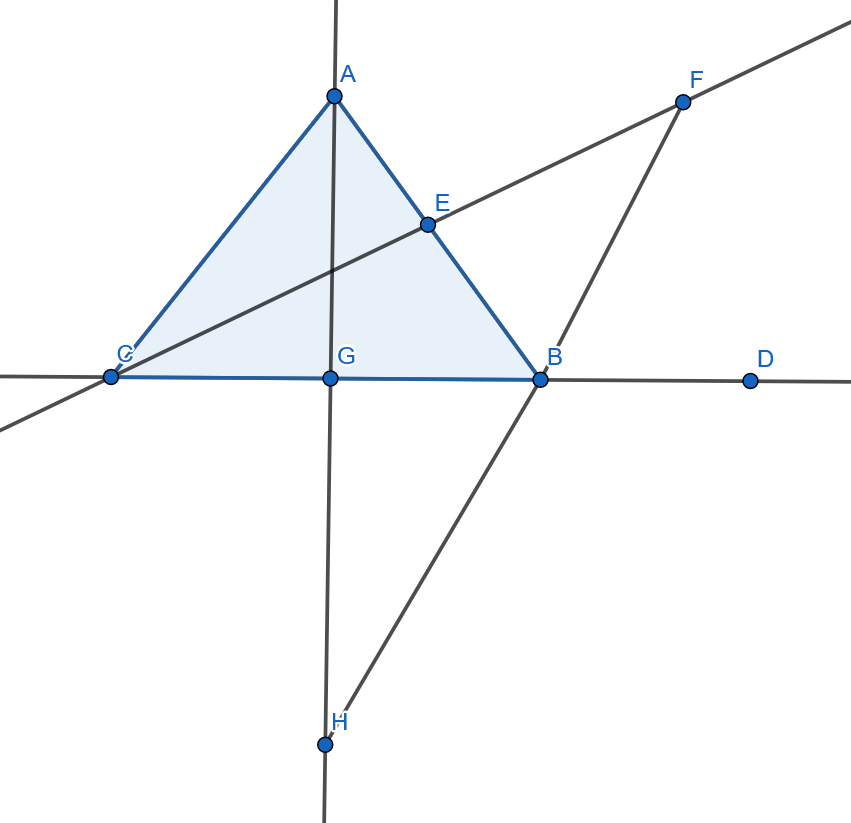
Suppose we have \(\triangle ABC\text{.}\) We can construct a ray from \(\angle ACB\) such that it goes through \(\overline{AB}\) and intersects it at point \(E\text{,}\) such that \(A-E-B\) and \(E\) is the midpoint of \(\overline{AB}\text{.}\) Thus, \(\overline{AE} \cong \overline{EB}\text{.}\)
By the Ruler Postulate, we then construct point \(F\) on the ray such that \(C-E-F\text{,}\) with \(E\) as the midpoint of \(\overline{CF}\text{.}\) Therefore, \(\overline{EF} \cong \overline{CE}\text{.}\)
By the Vertical Angle Theorem, \(\angle FEB \cong \angle AEC\text{.}\) Since \(\overline{CE} \cong \overline{EF}\) and \(\overline{AE} \cong \overline{EB}\text{,}\) it follows by SAS that
\begin{equation*} \triangle AEC \cong \triangle FEB. \end{equation*}
Thus,
\begin{equation*} \angle CAE \cong \angle EBF. \end{equation*}
By the Angle Addition Postulate,
\begin{align*} m\angle ABD &= m\angle EBF + m\angle FBD\\ &= m\angle CAE + m\angle FBD\\ &= m\angle CAB + m\angle FBD. \end{align*}
By Axiom 12, \(m\angle FBD \ne 0\text{.}\)

Definition 2.1.12 Congruent Triangles.

Two triangles are congruent if and only if all their sides and angles are congruent (\(\Delta ABC \cong \Delta DEF\)).

Subsection 2.1.2 Triangle Congruence Theorems

Checkpoint 2.1.13.

Determine if two triangles with two congruent sides and a congruent angle not between the two sides are congruent.

Proof.

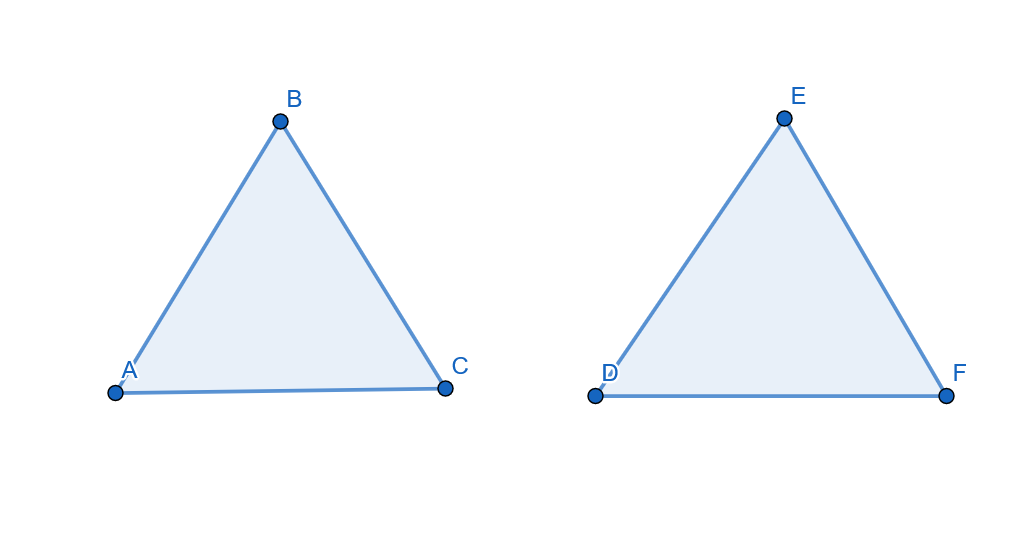
Suppose we have two triangles, \(\triangle ABC\) and \(\triangle DEF\text{,}\) with \(\angle BAC \cong \angle EDF\text{,}\) \(\angle ACB \cong \angle DFE\text{,}\) and \(\overline{AB} \cong \overline{DE}\text{.}\)
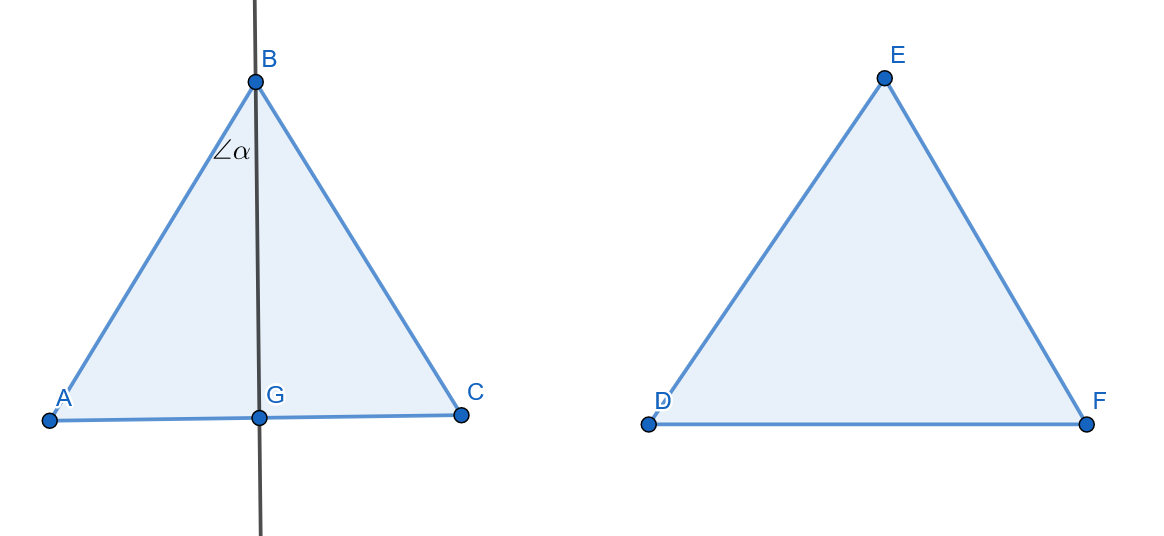
Assume, for contradiction, that \(m\angle ABC \gt m\angle DEF\text{.}\) We want to construct an angle \(\alpha\) such that \(\angle \alpha \cong \angle E\text{.}\) Using Axiom 18, we can construct a crossbar from \(\angle B\) that intersects \(\overline{AC}\text{,}\) constructing a point \(G\) such that \(A-G-C\text{.}\)
We now also have \(\angle \alpha \cong \angle E\text{.}\)
By doing this, through angle-side-angle, the \(\triangle ABG\) that we constructed is congruent to \(\triangle DEF\) and we have \(\angle AGB \cong \angle GCB \cong \angle DFE\text{.}\) But \(\angle AGB\) is an exterior angle of \(\angle BGC\text{,}\) by the exterior angle theorem, \(m\angle AGB \gt m\angle GCB\) and \(m\angle DFE\) which contradicts the definition of congruent triangles.

Proof.

( \(\Rightarrow\) ) Construct triangles \(\triangle ABC\) and \(\triangle DEF\) such that
\begin{align*} \overline{AB}&\cong\overline{DE},\\ \overline{BC}&\cong\overline{EF},\\ \overline{AC}&\cong\overline{DF}. \end{align*}
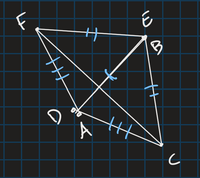
By the Angle Construction Postulate, we can construct a ray \(\overrightarrow{AP}\) such that \(m\angle PAB=m\angle FDE\text{,}\) where \(P\) and \(C\) are in separate half-planes separated by \(\overleftrightarrow{AB}\text{.}\) Then, on ray \(\overrightarrow{AP}\text{,}\) by the Ruler Postulate we can extend this ray and place a point \(F'\) such that \(\overline{AF'}\cong\overline{DF}\text{.}\) By Axiom 1, we can construct the line \(\overline{F'B}\text{.}\) Now, since \(\overline{AF'}\cong\overline{DF}\text{,}\) \(\overline{AB}\cong\overline{DE}\text{,}\) and \(\angle F'AB\cong\angle FDE\text{,}\) we know that \(\triangle ABF'\cong\triangle DEF\) by the SAS Postulate. For the sake of simplicity, we will re-label \(\triangle ABF'\) as \(\triangle DEF\text{.}\) So, we should have the following figure.
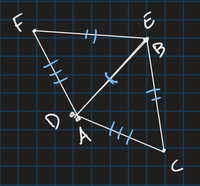
Essentially, we place \(\triangle DEF\) on \(\triangle ABC\) such that \(D\) overlaps \(A\) and \(E\) overlaps \(B\text{.}\) By axiom 1, we can construct the segment \(\overline{CF}\text{.}\)
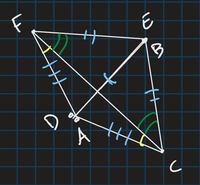
We observe the new triangles \(\triangle CDF\) and \(\triangle CBF\text{.}\) Since \(\overline{AC}\cong\overline{DF}\) and \(\overline{BC}\cong\overline{EF}\text{,}\) triangles \(\triangle CAF\) and \(\triangle CBF\) are isosceles. By the Isosceles Triangle Theorem, \(\angle ACF\cong\angle DFC\) and \(\angle BCF\cong\angle EFC\text{.}\)
Since \(F\) lies in the interior of \(\angle ACB\) and \(C\) lies in the interior of \(\angle DFE\text{,}\) by the Angle Addition Postulate,
\begin{align*} m\angle ACB&=m\angle ACF+m\angle BCF,\\ m\angle DFE&=m\angle DFC+m\angle EFC. \end{align*}
Using the fact that \(\angle ACF\cong\angle DFC\) and \(\angle BCF\cong\angle EFC\text{,}\) we see that
\begin{align*} m\angle ACB&=m\angle DFC+m\angle EFC=m\angle DFE. \end{align*}
So, we have that
  1. \(\overline{AC}\cong\overline{DF}\text{,}\)
  2. \(\overline{BC}\cong\overline{EF}\text{,}\)
  3. \(\angle ACB\cong\angle DFE\text{.}\)
By the SAS Postulate, \(\triangle ABC\cong\triangle DEF\text{.}\)
( \(\Leftarrow\) ) Suppose \(\triangle ABC\cong\triangle DEF\text{.}\) Then, by definition, their corresponding sides are congruent. So,
\begin{align*} \overline{AB}\cong\overline{DE},\\ \overline{BC}\cong\overline{EF},\\ \overline{AC}\cong\overline{DF}. \end{align*}

Proof.

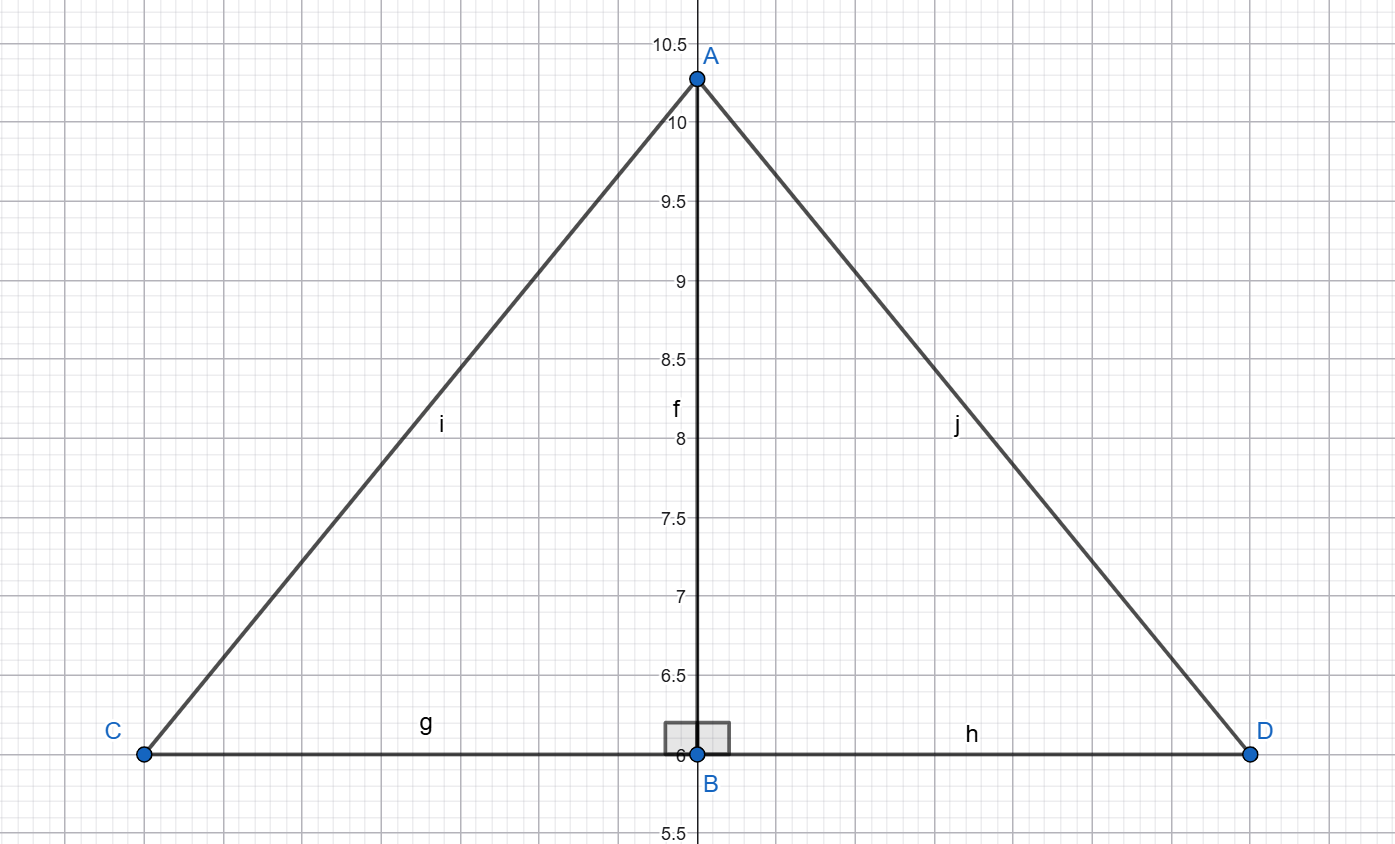
Image required for the proof of right angle side side theorem
Take the above figure and suppose that line segments \(i\) and \(j\) to be congruent and the angles \(\angle CBA\) and \(\angle DBA\) to be congruent. Note that line segment \(f\) is congruent to itself. Then, per the Isosceles Triangle Theorem, \(\angle ACB\cong\angle ADB\text{.}\) Thus, by our congruences, we know that \(\triangle ABC\cong\triangle ABD\) per Angle Angle Side congruence.

Proof.

Case 1: Where 1 side is longer than the others.
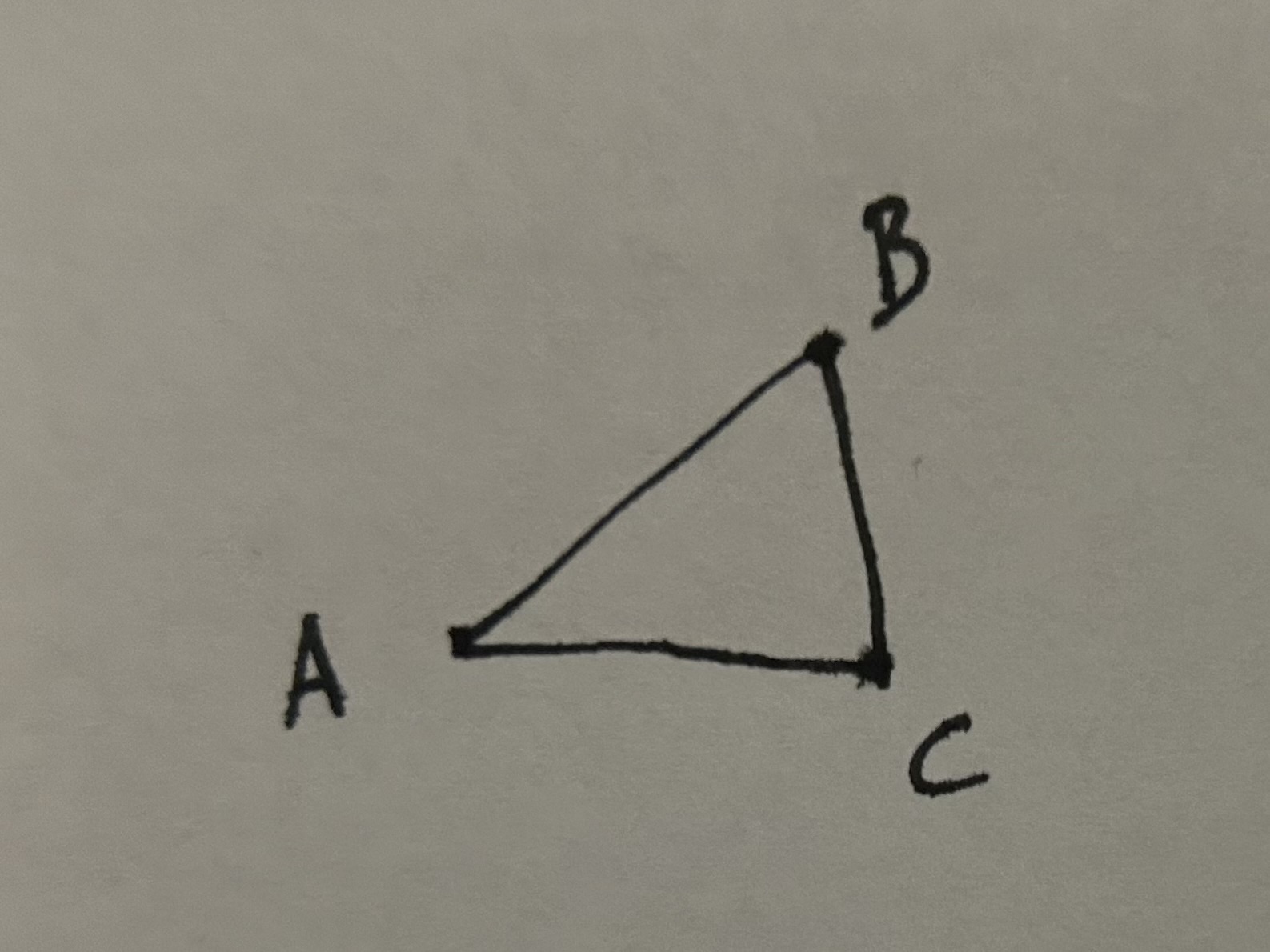
There exists some arbitrary triangle \(\triangle ABC\text{.}\) Assume that \(\overline{AB}\) is the longest side.
Subcase 1: \(|AB|+|AC| \gt |BC|\)
The length of \(\overline{AC}\) is a non-negative number and is being added to the longest side \(\overline{AB}\text{.}\) The sum will remain longer than the other side.
\(|AB| \gt |BC|\) then \(|AB|+|AC| \gt |BC|\) remains true.
Subcase 2: \(|AB|+|BC| \gt |AC|\)
Similar to Subcase 1.
Subcase 3: \(|AC|+|BC| \gt |AB|\)
Place a point D such that \(|AD|=|AC|\text{.}\) We need to show that \(|BC| \gt |DB|\) for the sum of the two sides to be greater than \(|AB|\text{.}\) By definition, \(\triangle ADC\) is an isosceles triangle and by the Isosceles Triangle theorem, the angles opposite the equal sides are congruent. \(m\angle ADC=m\angle DCA\text{.}\)
\(\angle ADC\) is an exterior angle to \(\triangle BDC\) and by the exterior angle theorem, \(m\angle ADC \gt m\angle BCD\text{.}\) \(\angle BDC\) is an exterior angle to \(\triangle ADC\text{,}\) so \(m\angle BDC \gt m\angle DCA\text{.}\) We know that \(\angle ADC\cong\angle DCA\) which means \(m\angle BDC \gt m\angle ADC\) but we also know that \(m\angle ADC \gt m\angle BCD\text{.}\) Therefore, \(m\angle BDC \gt m\angle BCD\text{.}\) By the extended inverse of isosceles triangle, \(|BC| \gt |DB|\text{.}\)
\(|AB|=|AD|+|DB|\) this equation becomes \(|AB|=|AC|+|DB|\text{.}\) Since we know that \(|BC| \gt |DB|\) this means \(|AC|+|BC| \gt |AB|\) which is what we wanted to prove.
Case 2: 2 or more sides are equal
This means for some \(\triangle ABC\) where \(|AB|=|AC|=|BC|\) then for the sum of any two sides, \(2|AB| \gt |AB|\) which proves the theorem.