Section 1.1 Finite Geometries

Definition 1.1.1 Intersect.

Two lines intersect if and only if they share a point.

Definition 1.1.2 Parallel.

Two lines are parallel if and only if they do not intersect.

Definition 1.1.3 Four Point Geometry.

The four point geometry is defined by the following axioms and definitions.
  1. There exist exactly four points.
  2. Any two, distinct points have exactly one line on them.
  3. Each line is on exactly two points.

Checkpoint 1.1.4.

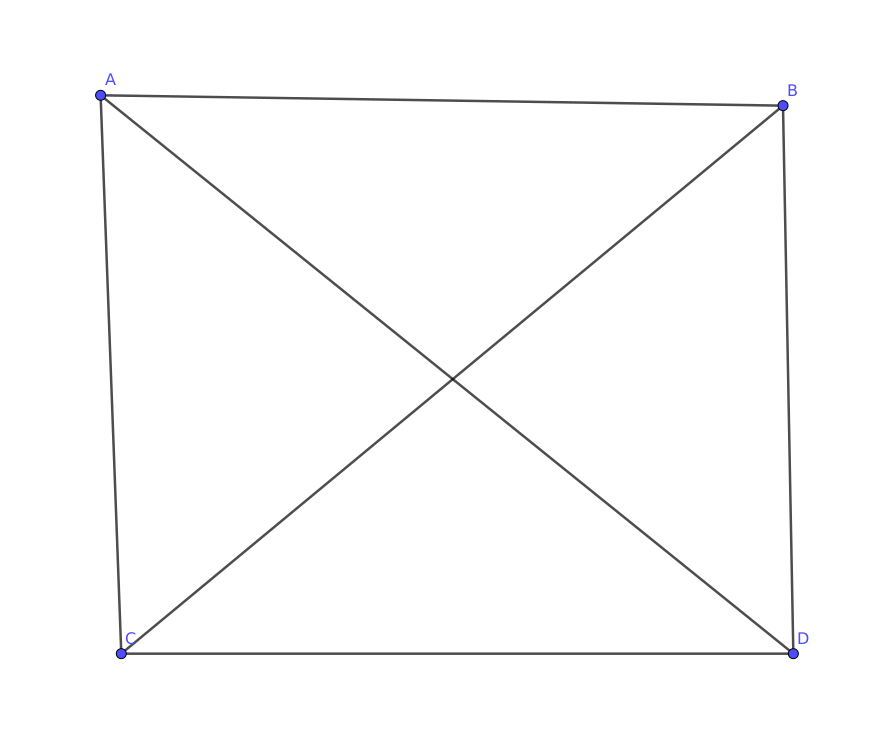
Explore the four point geometry as follows.

(b)

Use axiom 2 to draw as many lines as possible.
Solution.

(d)

Find a pair of parallel lines.
Solution.
\(\boxed{\overleftrightarrow{AB} \parallel \overleftrightarrow{CD}}\text{,}\) \(\boxed{\overleftrightarrow{AC} \parallel \overleftrightarrow{BD}}\text{,}\) \(\boxed{\overleftrightarrow{AD} \parallel \overleftrightarrow{BC}}\)

(e)

Can you find three lines that are pairwise parallel?
Solution.
No.

(f)

Can you find a point that is on three lines?
Solution.
Any point.
The four point geometry is an affine geometry. We are also interested in projective geometries.

Definition 1.1.5 Projective Geometry.

A finite projective geometry satisfies the following conditions.
  1. Any two, distinct points have exactly one line on them.
  2. There are at least four points with no three on the same line.
  3. Any two, distinct lines share at least one point.

Checkpoint 1.1.6.

Construct a projective geometry with exactly 4 points on every line.
Solution.
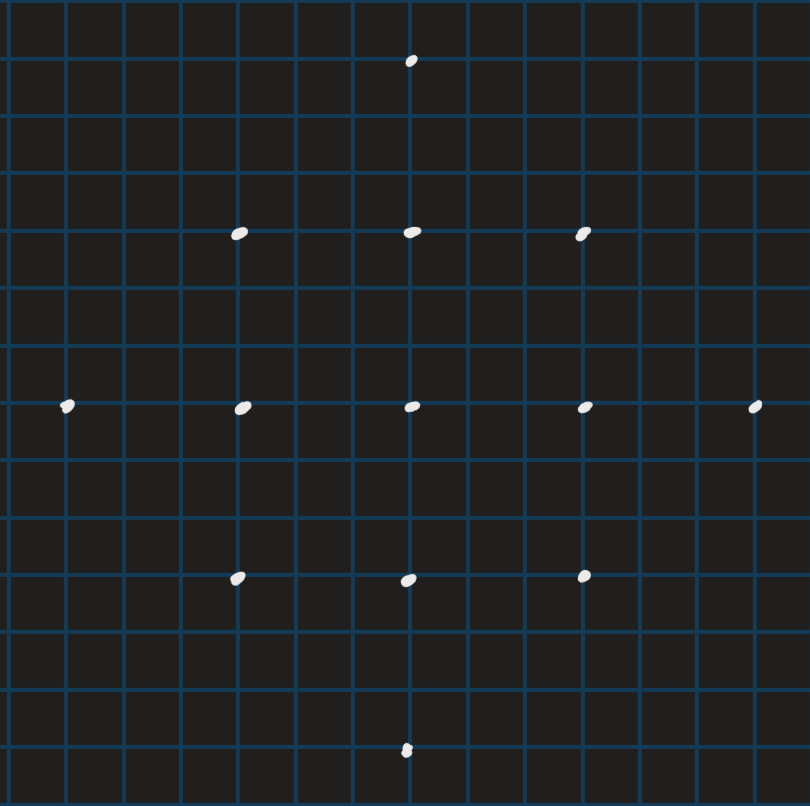
Place 9 points in a \(3\times 3\) grid. Then, place four more points above, below, and to the left and right of the grid.
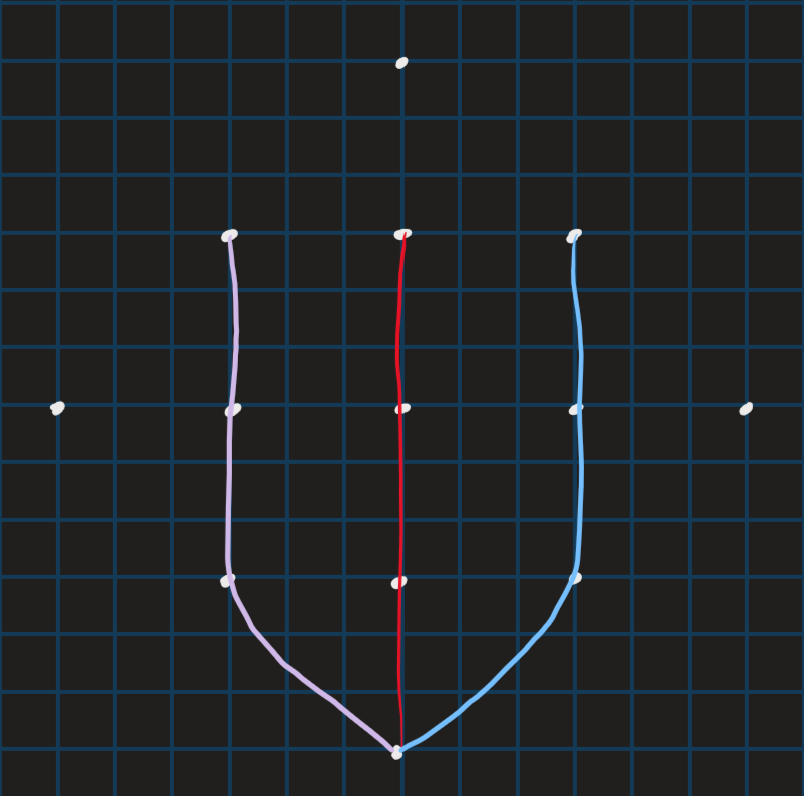
We want every line to contain exactly four points. So, we can draw the following lines.
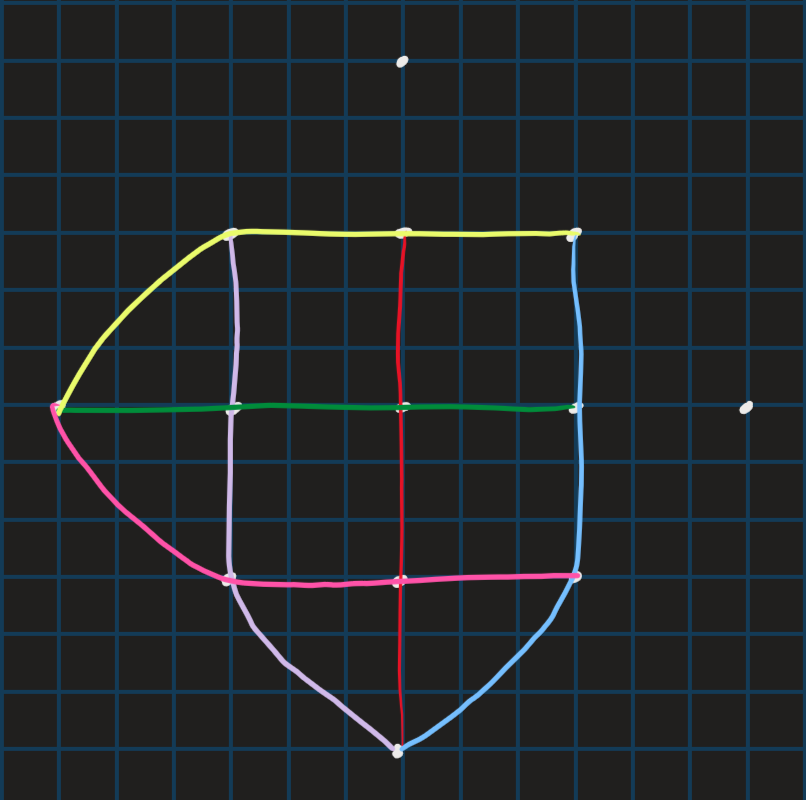
We arrange the lines in this way to not violate axiom 3 of the Finite Projective Geometry. Then, notice we can repeat this pattern as follows.
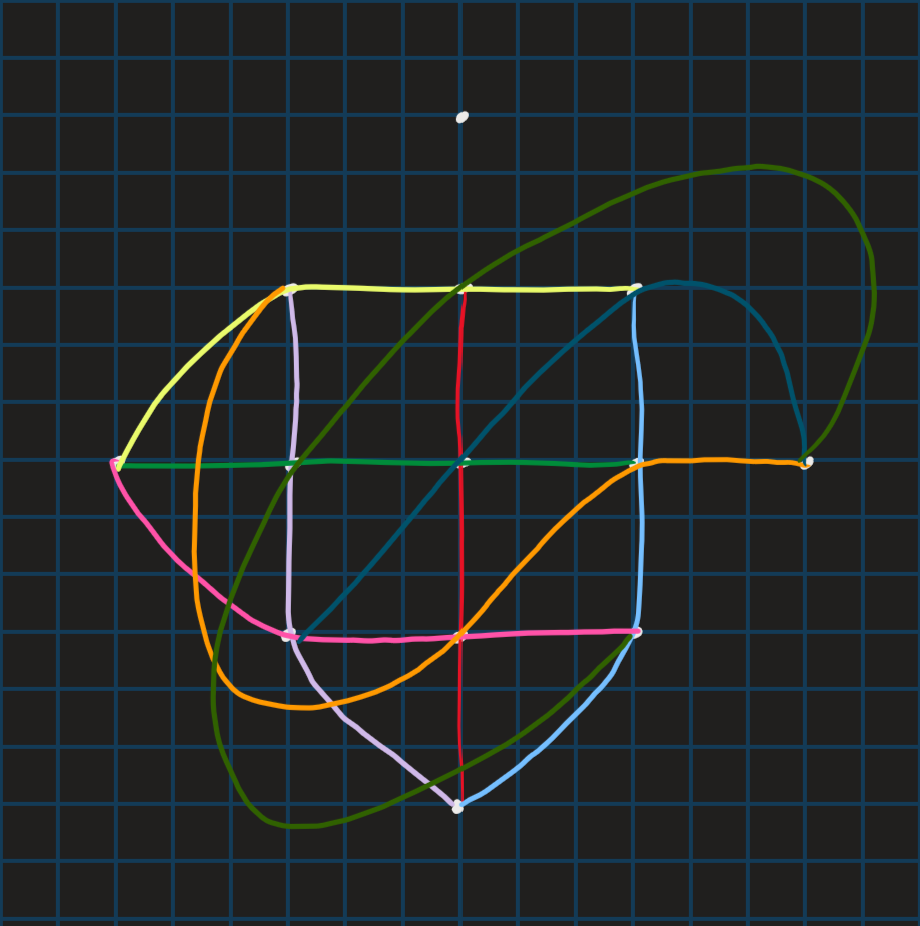
Once again, we satisfy axiom 3. But, we cannot repeat this pattern again since we would be violating axiom 1. So, we have to come up with a different strategy to connect our top and rightmost points with the rest of the diagram such that we do not violate axiom 1. Instead of attaching the points along the verticals and horizontals, we can attack from the diagonals like so.
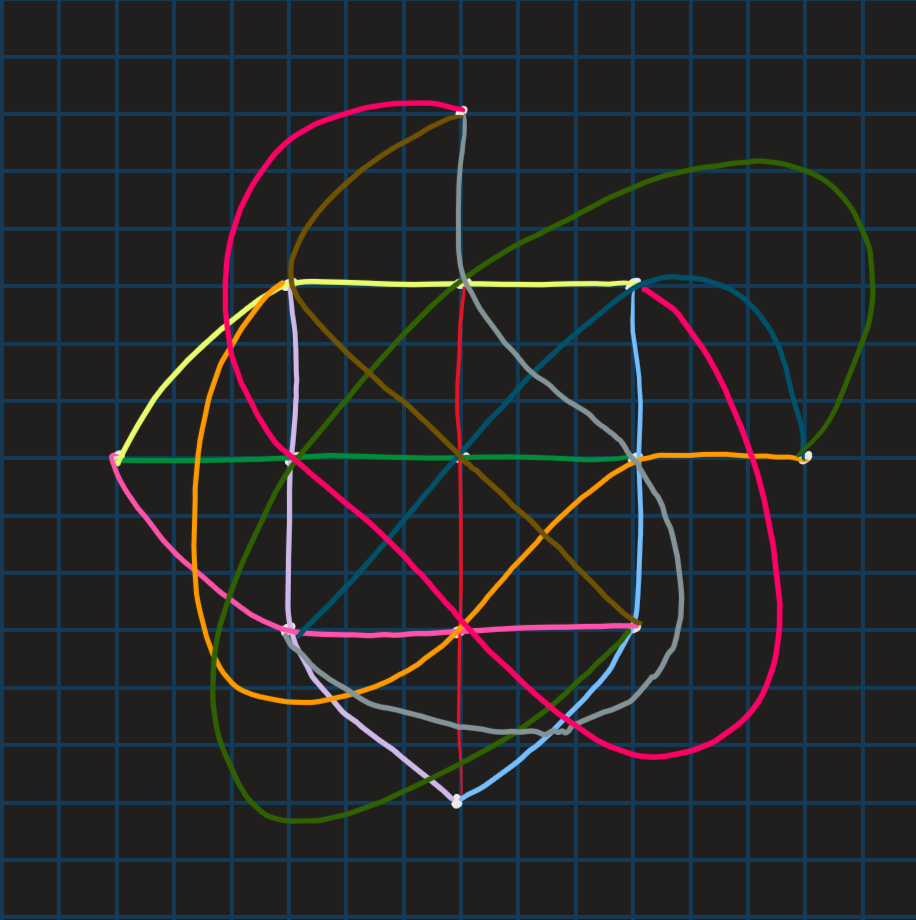
If we draw our lines this way, we still satisfy all the axioms. Now, notice we can repeat this same method of attachment on our topmost point.
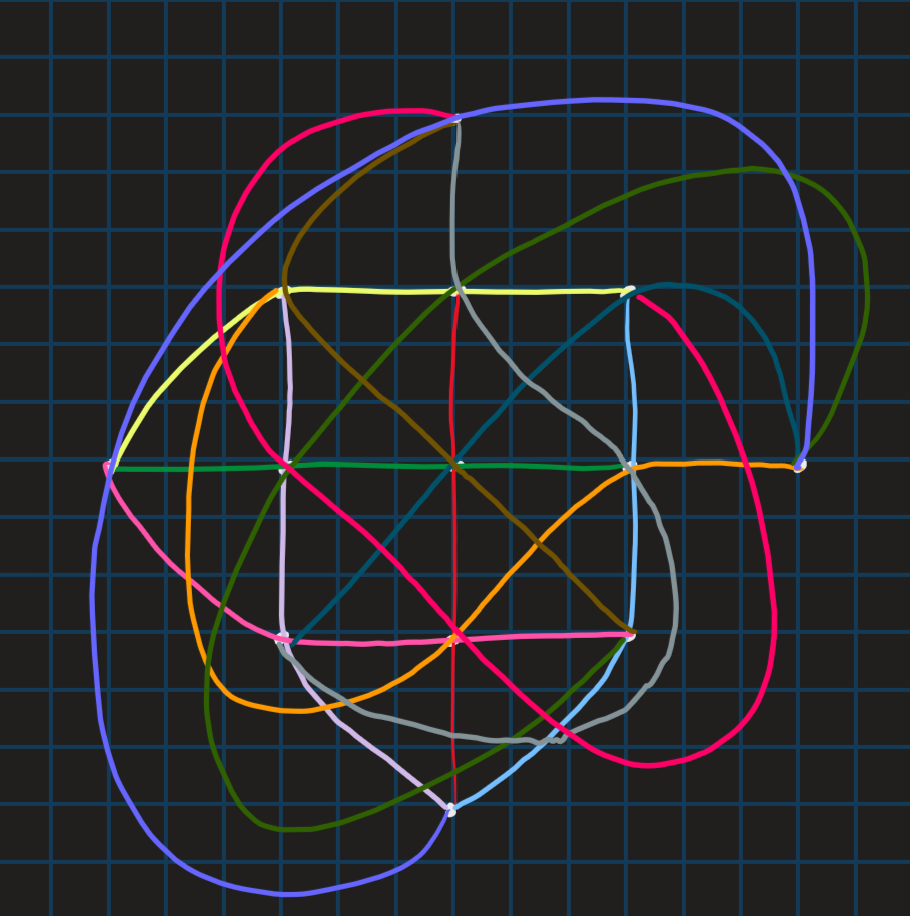
Finally, we need to connect our 4 outermost dots to satisfy axiom 1.
We see that this final image satisfies the three axioms of the finite projective geometry:
  1. Every two distinct points have exactly one line on them,
  2. There are at least four points with no three on the same line,
  3. Every two lines have at least one point on them both.
To see how we satisfy axiom 2, we can pick the centermost point, the topmost post, the rightmost point, and the left middle point of the \(3\times3\) grid. Further, as per the problem statement, each line has exactly four points on it.