Skip to main content
Contents
Search Book
Search Results:
No results.
Read aloud Readability settings Prev Up Next \(\newcommand{\R}{\mathbb{R}}
\newcommand{\lt}{<}
\newcommand{\gt}{>}
\newcommand{\amp}{&}
\definecolor{fillinmathshade}{gray}{0.9}
\newcommand{\fillinmath}[1]{\mathchoice{\colorbox{fillinmathshade}{$\displaystyle \phantom{\,#1\,}$}}{\colorbox{fillinmathshade}{$\textstyle \phantom{\,#1\,}$}}{\colorbox{fillinmathshade}{$\scriptstyle \phantom{\,#1\,}$}}{\colorbox{fillinmathshade}{$\scriptscriptstyle\phantom{\,#1\,}$}}}
\)
Section 1.2 Completeness
Definition 1.2.1 Fano Geometry (attempt 1).
There exists at least one line.
There are exactly three points on every line.
Not all points are on the same line.
Checkpoint 1.2.2 .
Use the definition above and the previous definitions of intersection and parallel to explore the Fano geometry as follows.
(a) Draw a line using Geogebra.
(b) Add a third point to the line.
(c) Axiom 3 requires one more point. Draw one.
(d) Must any more lines be added? If so, do so.
(e) By continuing this process of adding required points and lines, determine how many lines are in this geometry.
Solution .
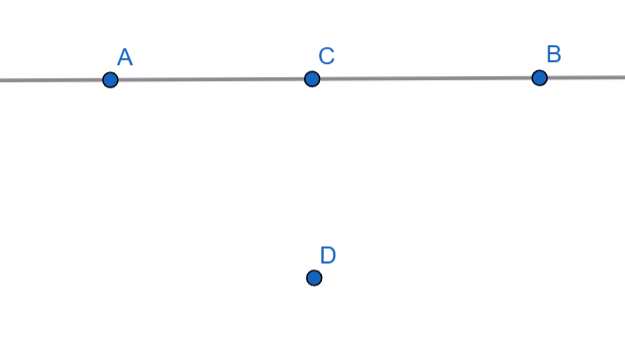
Following the instructions and the axioms, there is only one line in this geometry and four points, with one point outside of the line. There is nothing in the axioms that forces us to draw a line to connect the point outside of the line with the other points so this could be left as it is.
(f) Add the axiom: every point is on at least one line.
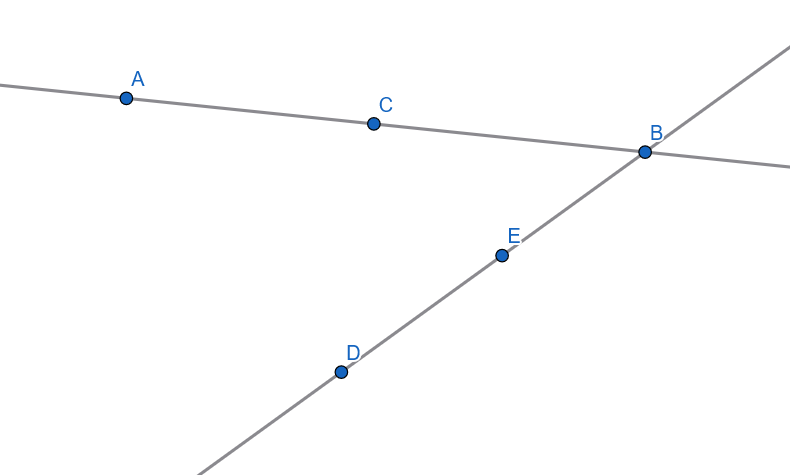
(g) To your line with three points, and one point not on that line add any lines required by this new axiom.
(h) Make sure these lines satisfy Axiom 2.
(i) How many lines are in this geometry now?
(j) May any more lines be added? If so, do so, and be sure all the axioms are satisfied.
(k) How many lines are in this geometry?
(l) (m) What is needed to fix the difficulty noted in the previous question?