Skip to main content\(\newcommand{\R}{\mathbb{R}}
\newcommand{\lt}{<}
\newcommand{\gt}{>}
\newcommand{\amp}{&}
\definecolor{fillinmathshade}{gray}{0.9}
\newcommand{\fillinmath}[1]{\mathchoice{\colorbox{fillinmathshade}{$\displaystyle \phantom{\,#1\,}$}}{\colorbox{fillinmathshade}{$\textstyle \phantom{\,#1\,}$}}{\colorbox{fillinmathshade}{$\scriptstyle \phantom{\,#1\,}$}}{\colorbox{fillinmathshade}{$\scriptscriptstyle\phantom{\,#1\,}$}}}
\)
Section 1.3 Consistency
Definition 1.3.1 Nine Point Geometry.
Use the following axioms and definitions of intersection and parallel as an alleged definition of the nine point geometry.
-
There exist exactly nine points.
-
There exist exactly nine lines.
-
Any two, distinct points have exactly one line on them.
-
Each line is on exactly three points.
Checkpoint 1.3.2.
Explore the alleged nine point geometry as follows.
(a)
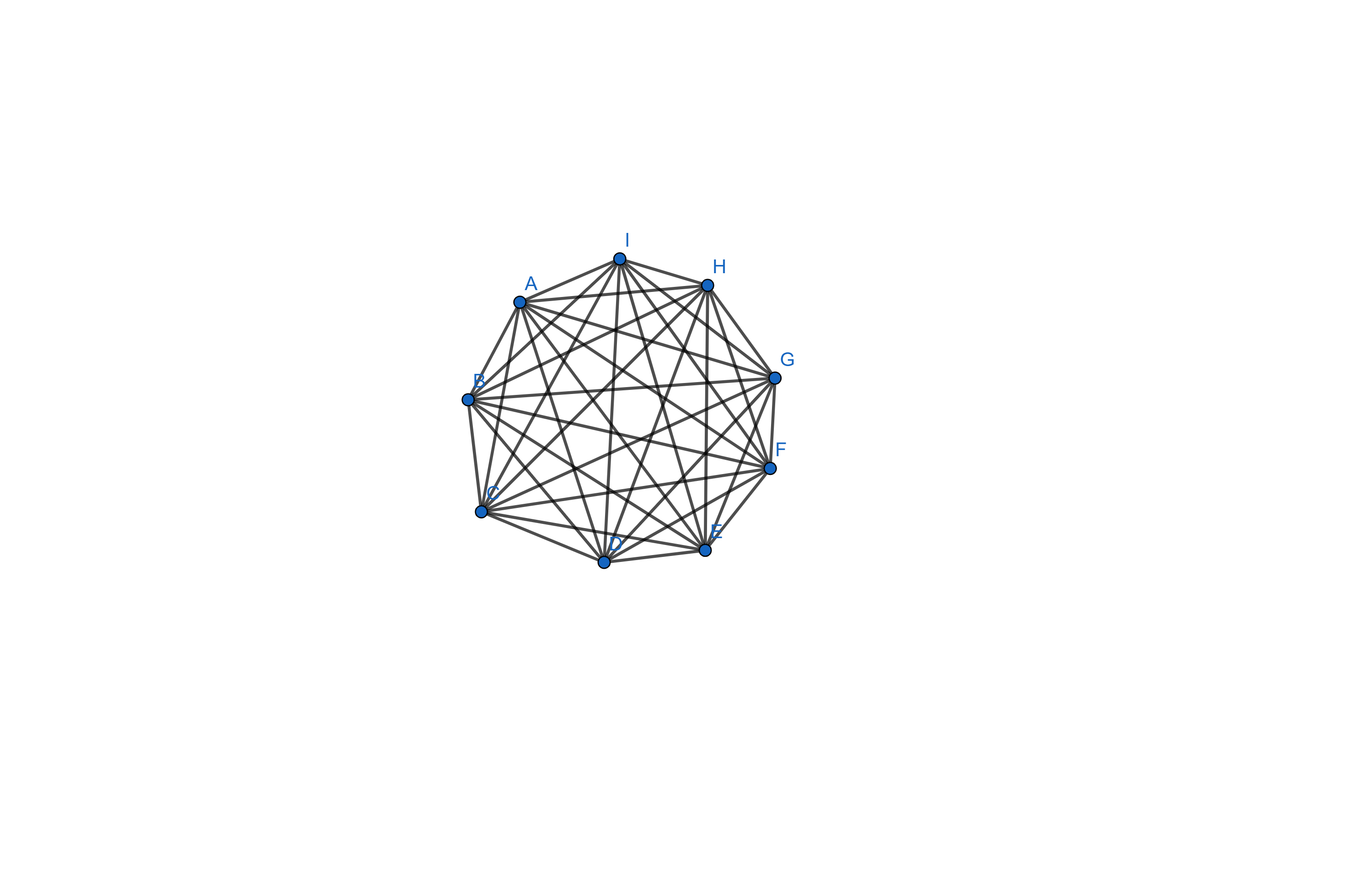
Draw nine points using Geogebra.
(b)
Use Axiom 3 to draw all required lines.
(c)
How many lines did you construct?
Solution.
Using the formula for edges of a complete graph with n vertices:
\begin{equation*}
E = \frac{n(n-1)}{2}.
\end{equation*}
For nine points, this gives:
\begin{equation*}
E = \frac{9(9-1)}{2} = 36.
\end{equation*}
(d)
Compare this answer to Axiom 2.
Solution.
Axiom two restricts us to nine lines.