Section 3.1 Equivalent Parallel Postulates

Each of the following is an equivalent Euclidean postulate.
List 3.1.1. Equivalent Euclidean Postulates
  • (Playfair) Given a line and a point not on that line, there exists exactly one line through that point parallel to the given line.
  • (Equidistance) Lines that are parallel are everywhere equidistant.
  • (Euclid) Given two lines and a transversal of those lines, if the sum of the angles on one side of the transversal is less than two right angles then the lines meet on that side.

Subsection 3.1.1 Preparation

These theorems do not require a parallel postulate.

Proof.

By Definition, parallel lines do not intersect.
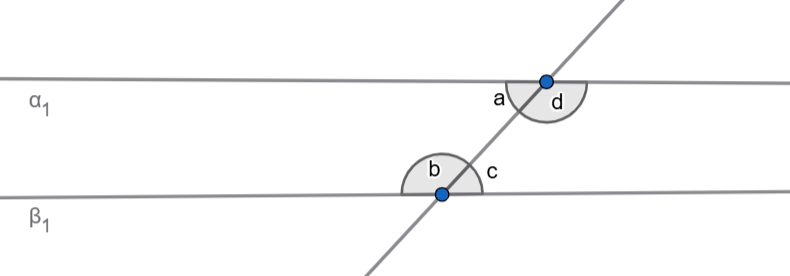
Image required for the proof of Theorem 3-1-2.
Suppose \(m(\angle a)=m(\angle c)\text{.}\)
Suppose that \(\alpha\) and \(\beta\) intersect to the left of our transversal. Then we have a triangle, and by the Exterior Angle Theorem, \(m(\angle a)<m(\angle c)\text{.}\) \(\rightarrow\!\leftarrow\)
As a similar argument applies to intersections on the right, the theorem is proven.

Proof.

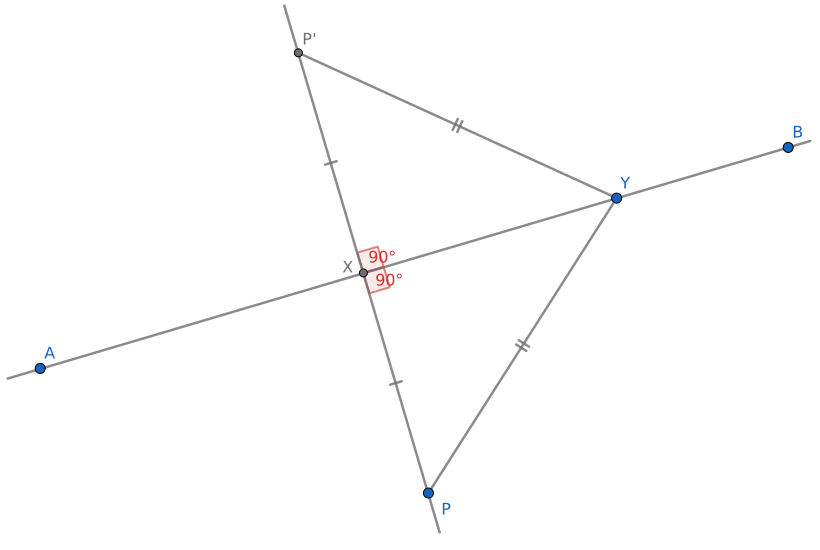
Consider line \(\overleftrightarrow{AB}\) and a point \(P\) not on the line. Let point \(X\) be the foot of the perpendicular from point \(P\) to line \(\overleftrightarrow{AB}\text{.}\)
For the sake of contradiction, suppose \(|PX|\) is not the shortest distance from \(P\) to \(\overleftrightarrow{AB}\text{.}\) Then, there exists a point \(Y\) on \(\overleftrightarrow{AB}\) such that \(|PY|<|PX|\text{.}\) By the Ruler Postulate, we can extend \(\overline{PX}\) and place a point \(P'\) on \(\overline{PX}\) such that \(\overline{PX}\cong\overline{P'X}\text{.}\) Then, by axiom 1, we can create segment \(\overline{P'Y}\text{.}\) Since \(\angle YXP\) is a right angle, so is \(\angle YXP'\) by the Supplement Postulate. Further, \(\overline{XY}\cong\overline{XY}\) by reflexivity. Thus, by the SAS Postulate, \(\triangle PXY\cong\triangle P'XY\text{.}\) So, \(\overline{PY}\cong\overline{P'Y}\text{.}\) By the Triangle Inequality,
\begin{equation*} |PY|+|P'Y|>|PP'|. \end{equation*}
But, \(\overline{PY}\cong\overline{P'Y}\) and \(|PP'|=2|PX|\) since \(\overline{PX}\cong\overline{P'X}\text{.}\) Thus,
\begin{equation*} 2|PY|>2|PX|\implies |PX|>|PX|, \end{equation*}
which is a contradiction. Hence, \(|PX|\) must be the shortest distance from point \(P\) to \(\overleftrightarrow{AB}\text{.}\)

Proof.

Consider two lines with a transversal. Let the angles on one side of the transversal be labeled \(A\) and \(B\text{,}\) with \(C\) being supplementary to \(B\text{.}\)
Suppose
\begin{equation*} mA + mB = 180^\circ. \end{equation*}
Since \(B\) and \(C\) are supplementary,
\begin{equation*} mB + mC = 180^\circ. \end{equation*}
Therefore,
\begin{equation*} mA + mB = mB + mC. \end{equation*}
Subtracting \(mB\) from both sides gives
\begin{equation*} mA = mC. \end{equation*}
Therefore, \(A\) and \(C\) are congruent alternate interior angles. By Theorem 3.1.2 (Alternate Interior Angles), the lines are parallel.

Subsection 3.1.2 Equivalency

The following theorem produces an easier to use version of Euclid’s postulate.

Proof.

Consider a line \(l \) and a point \(A \) not on that line.
Playfair’s axiom states that there is exactly one line through \(A \) parallel to \(l \text{.}\) Now draw a transversal through \(A \) that intersects \(l \text{.}\) Let \(\alpha \) and \(\beta \) denote a pair of alternate interior angles formed by the transversal and the two lines. Suppose that \(m\angle\alpha \ne m\angle\beta \text{.}\)
We can construct a line through \(A \) such that its alternate interior angle is congruent to \(\beta \text{.}\) Denote this new angle by \(\alpha' \text{,}\) so that \(m\angle\alpha' = m\angle\beta \text{.}\)
By the Alternate Interior Angle Theorem, this new line is parallel to \(l \text{.}\) Thus, we have constructed a line through \(A \) that is parallel to \(l \) and distinct from the original parallel line.
This contradicts Playfair’s axiom, which states that there is exactly one line through \(A \) parallel to \(l \text{.}\)
Therefore, \(m\angle\alpha = m\angle\beta \text{,}\) and hence Playfair’s axiom implies the Alternate Interior Angle Converse Theorem.
The alternate interior angle converse theorem states ``Given parallel lines and a transversal of those lines, the alternate interior angles formed by the transversal are congruent.’’

Proof.

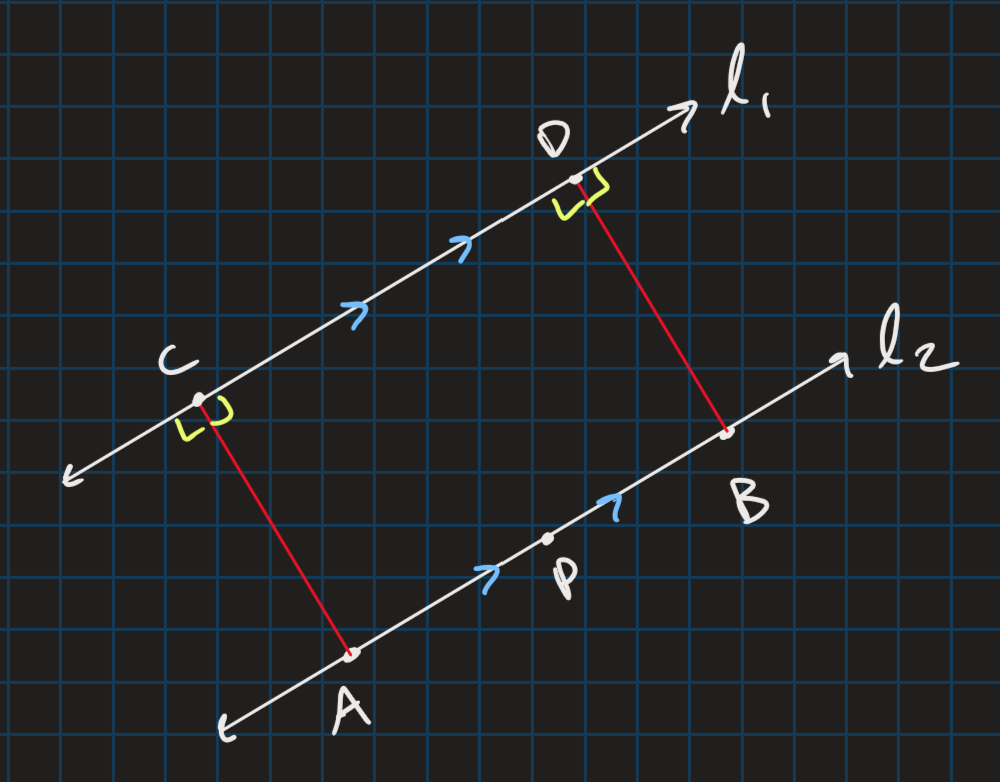
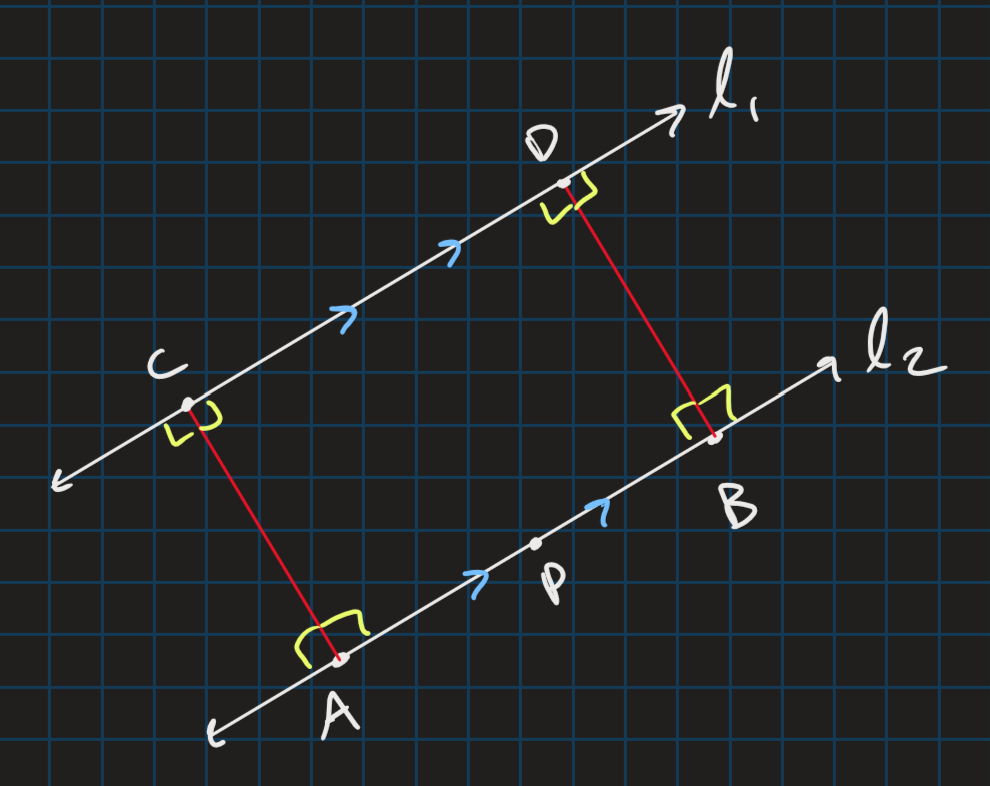
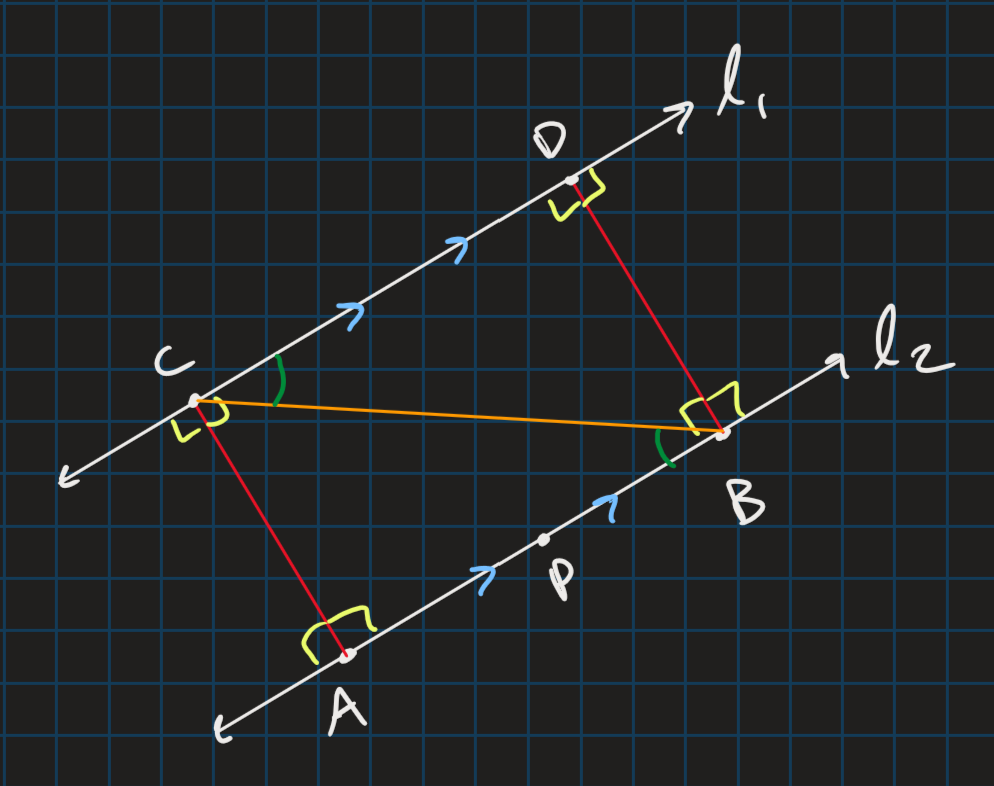
Let \(P\) be a point not on line \(\ell_{1}\text{.}\) Then, by Playfair, there exists exactly one line \(\ell_{2}\) such that \(P\) lies in \(\ell_{2}\) and \(\ell_{1}\parallel\ell_{2}\text{.}\) Choose two arbitrary points \(A\) and \(B\) on \(\ell_{2}\text{.}\) By Theorem 3.1.3, the closest distance from \(A\) to \(\ell_{1}\) is from \(A\) to the foot of the perpendicular. Let \(C\) be the point at the foot of the perpendicular on \(\ell_{1}\) from \(A\text{.}\) Similarly, let \(D\) be the point at the foot of the perpendicular on \(\ell_{1}\) when finding the distance from \(B\) to \(\ell_{1}\text{.}\)
We claim that \(\overline{AC}\cong\overline{BD}\text{.}\) Since \(\ell_{1}\parallel\ell_{2}\text{,}\) by the alternating interior angle converse theorem, the angles at the intersection of \(\overline{AC}\) and \(\ell_{2}\) are right angles and same with \(\overline{BD}\text{.}\)
By axiom 1, we can construct segment \(\overline{BC}\text{.}\) Then, by the alternating interior angle converse theorem, \(\angle ABC\cong\angle DCB\text{.}\)
By reflexivity, \(\overline{BC}\) is congruent to itself. So, we have that
  1. \(\angle ABC\cong\angle DCB\text{,}\)
  2. \(\angle CAB\cong\angle BDC\text{,}\)
  3. \(\overline{BC}\cong\overline{BC}\text{.}\)
By Angle-Angle-Side, \(\triangle ABC\cong\triangle DCB\text{,}\) making \(\overline{AC}\cong\overline{BD}\) as desired. Since \(A\) and \(B\) were arbitrary points, parallel lines \(\ell_{1}\) and \(\ell_{2}\) are everywhere equidistant.

Proof.

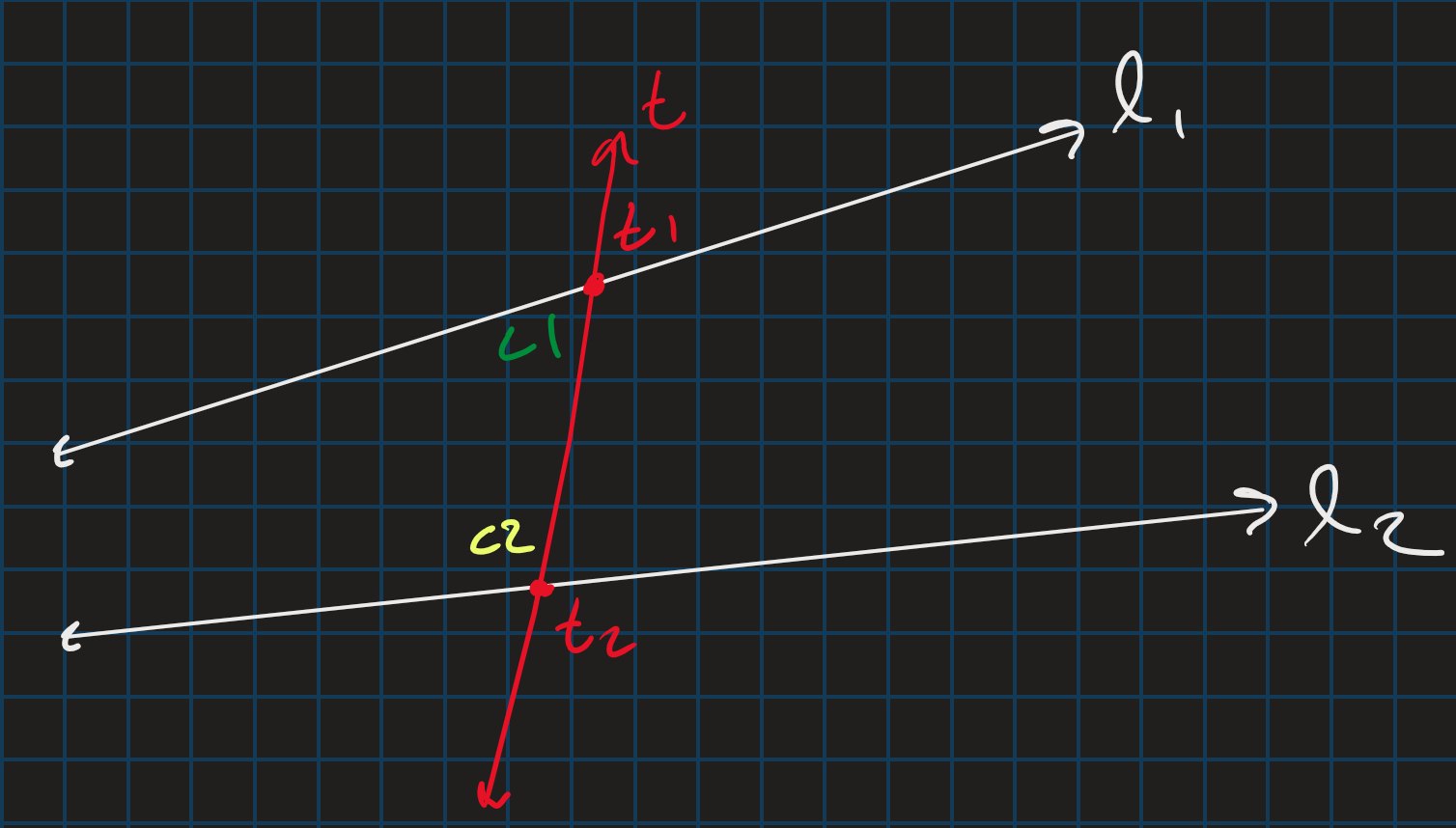
Let \(\ell_{1}\) and \(\ell_{2}\) be a pair of lines with a transversal \(t\) that intersects \(\ell_{1}\) at point \(t_{1}\) and \(\ell_{2}\) at point \(t_{2}\) such that the sum of the angles on one side of \(t\text{,}\) say \(\angle1\) and \(\angle2\text{,}\) is less than two right angles. We claim that \(\ell_{1}\) and \(\ell_{2}\) intersect on the same side of the transversal as \(\angle1\) and \(\angle2\text{.}\)
Assume the contrary, that is \(\ell_{1}\) and \(\ell_{2}\) do not intersect on the same side of \(t\) as \(\angle1\) and \(\angle2\text{.}\) Then, we have two cases: \(\ell_{1}\parallel\ell_{2}\) or \(\ell_{1}\) intersects with \(\ell_{2}\) on the other side of \(t\text{.}\)
Case 1: \(\ell_{1}\parallel\ell_{2}\text{:}\) Since parallel lines are equidistant, assume the distance between \(\ell_{1}\) and \(\ell_{2}\) is \(d>0\text{.}\) Here, we will explore two subcases.
Subcase 1.1: \(m\angle1<\pi/2\) and \(m\angle2<\pi/2\text{:}\) Then, we know that \(|t_{1}t_{2}|\) is not the shortest distance from \(t_{1}\) to \(\ell_{2}\) and \(t_{2}\) to \(\ell_{1}\) by Theorem 3.1.3. So, draw the distance lines from each point to the opposing line.
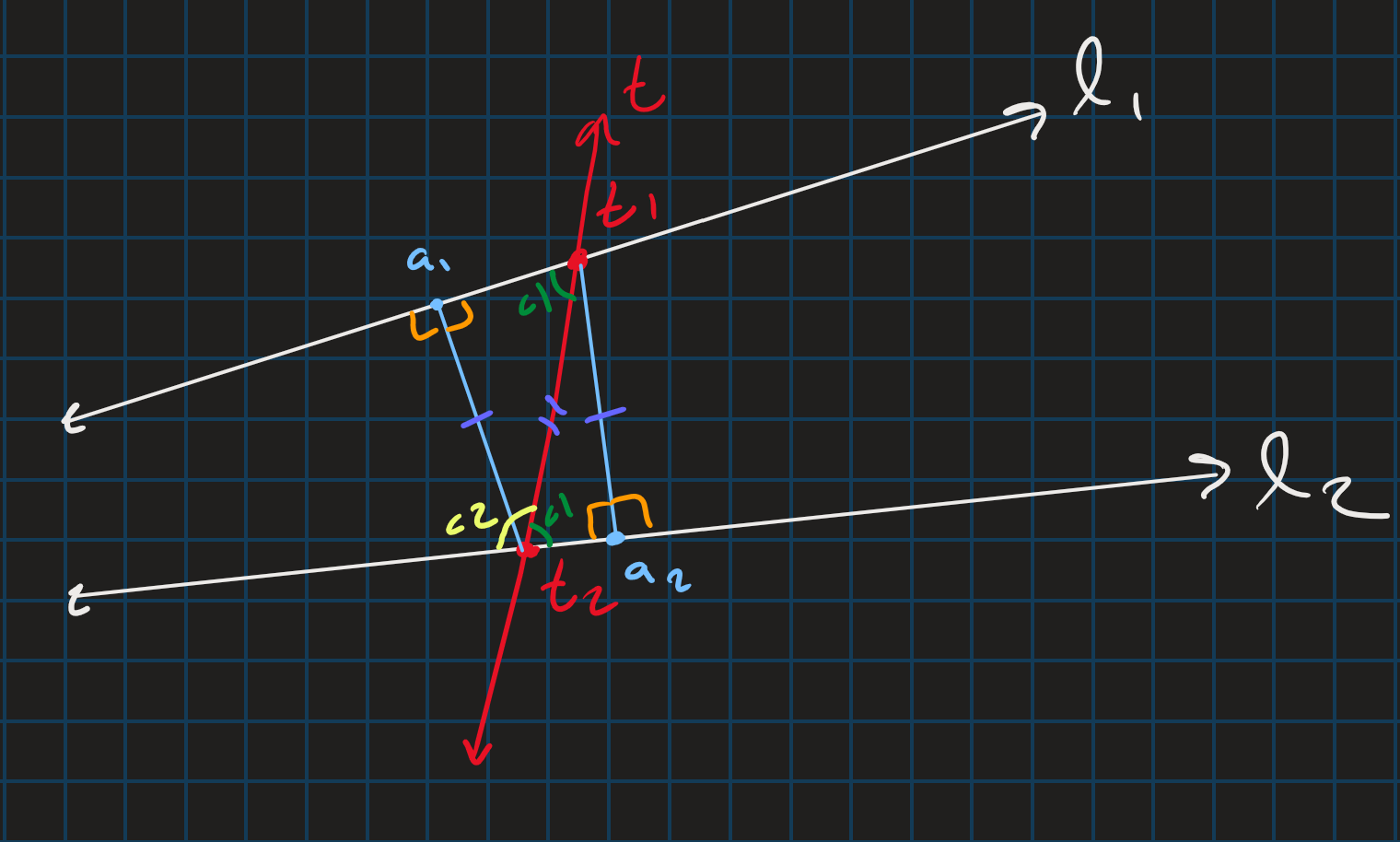
If \(\ell_{1}\parallel\ell_{2}\text{,}\) we know that \(|t_{1}a_{2}|=|t_{2}a_{1}|=d\) since parallel lines are equidistant. By reflexivity, \(\overline{t_1t_2}\cong\overline{t_2t_1}\text{.}\) Further, by Theorem 3.1.3 we know that \(m\angle t_{1}a_{2}t_{2}=m\angle t_{2}a_{1}t_{1}=\pi/2\text{.}\) So, by Right Angle-Side-Side, \(\triangle t_{1}a_{2}t_{2}\cong\triangle t_{1}a_{1}t_{2}\) and therefore \(\angle 1\cong \angle t_{1}t_{2}a_{2}\text{.}\) By the Supplement Postulate,
\begin{equation*} m\angle2+m\angle t_{1}t_{2}a_{2}=\pi\implies m\angle2+m\angle1=\pi, \end{equation*}
which is a contradiction since we are assuming \(m\angle1+m\angle2<\pi\text{.}\) Note that the same reasoning would apply if instead \(\angle 2\) was an interior angle to a triangle instead of \(\angle 1\) (that is, if instead \(t\) crossed \(\ell_{1}\) first when going from left to right or if \(\angle 1\) and \(\angle 2\) were on the other side of \(t\) in the figure.)
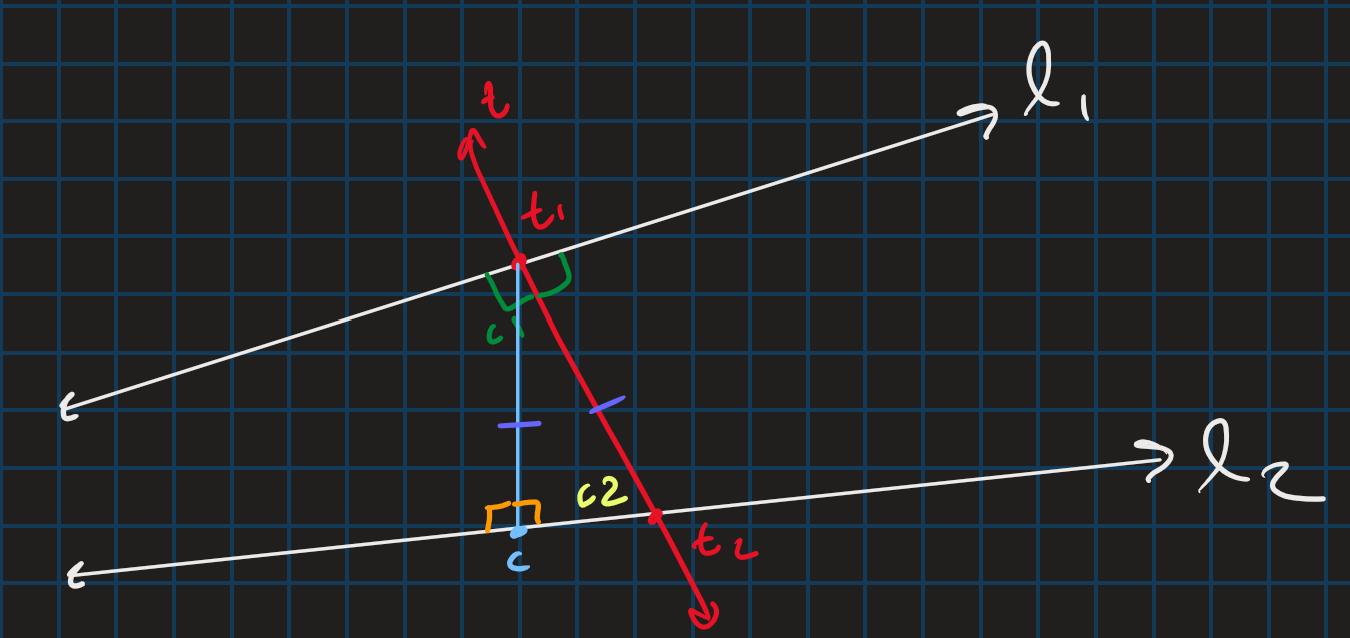
Subcase 1.2: \(m\angle1=\pi/2\) and \(m\angle2 < \pi/2\text{:}\) Then, \(\overline{t_1t_2}\) is the shortest distance from \(t_{2}\) to \(\ell_{1}\) by Theorem 3.1.3 and thus \(|t_{1}t_{2}|=d\text{.}\) Now, we have even more cases. If the distance line from \(t_{1}\) to \(\ell_{2}\) is on the same side of \(t\) as \(\angle 2\text{,}\) then we have the following figure.
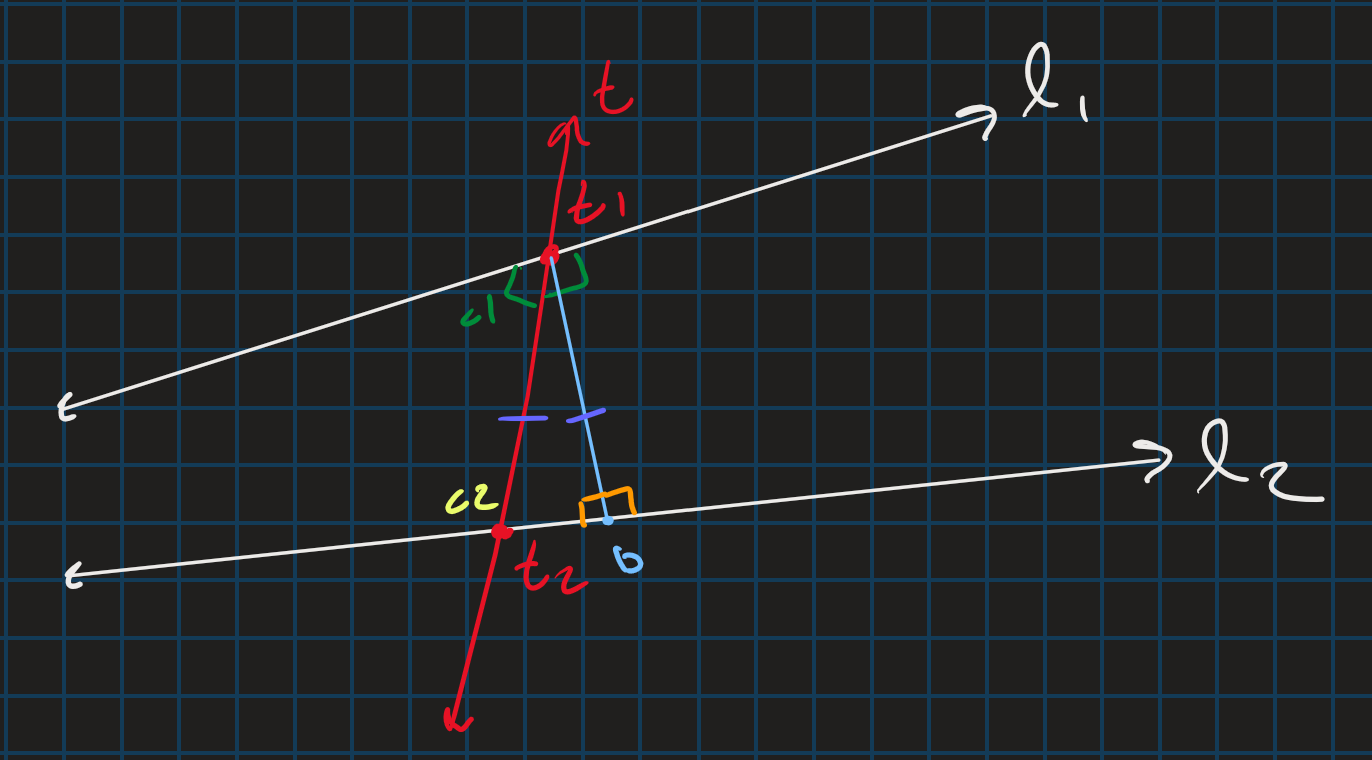
Since \(\ell_{1}\parallel\ell_{2}\text{,}\) \(|t_{1}c|=d\) as well. Thus, by the property of isosceles triangles (Theorem 2.1.8) \(m\angle2=\pi/2\text{,}\) which is a contradiction. If instead the distance line from \(t_{1}\) to \(\ell_{2}\) is on the other side of \(t\text{,}\) then we have the following figure.
Again, by the properties of isosceles triangles \(m\angle t_{1}t_{2}b=\pi/2\) and by the supplement postulate \(m\angle2=\pi/2\text{,}\) which is a contradiction. A similar reasoning applies when instead \(m\angle1<\pi/2\) and \(m\angle2=\pi/2\text{.}\)
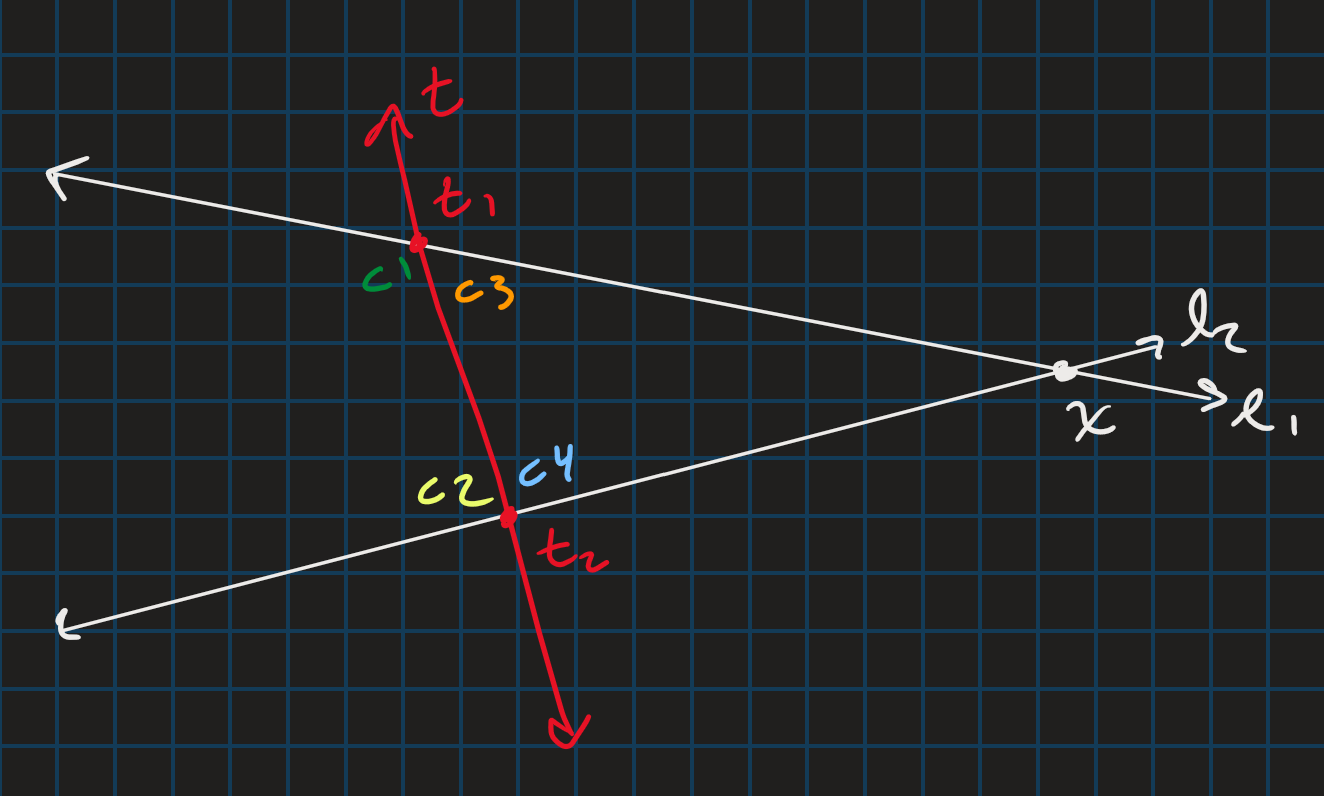
Case 2: \(\ell_{1}\) and \(\ell_{2}\) intersect on the other side of \(t\text{:}\) Suppose \(\ell_{1}\) and \(\ell_{2}\) intersect at a point \(X\) on the other side of \(t\text{.}\)
Then, by the Supplement Postulate,
\begin{align*} m\angle3 \amp =\pi-m\angle1,\\ m\angle4 \amp =\pi-m\angle2. \end{align*}
Further, by the Exterior Angle Theorem,
\begin{align*} m\angle1 > m\angle4 \amp \implies m\angle1 > \pi-m\angle 2,\\ m\angle2 > m\angle3 \amp \implies m\angle2 > \pi-m\angle 1. \end{align*}
Adding the inequalities, we get
\begin{align*} m\angle1+m\angle2 \amp >2\pi-m\angle1-m\angle2,\\ \implies 2m\angle1+2m\angle2 \amp >2\pi,\\ \implies m\angle1+m\angle2 \amp >\pi, \end{align*}
which is a contradiction. Hence, if \(m\angle1+m\angle2<\pi\text{,}\) then \(\ell_{1}\) and \(\ell_{2}\) must intersect on the same side of \(t\) as \(\angle1\) and \(\angle2\text{.}\)
One should notice that in the process of proving this theorem, we showed that if two lines are parallel, then the angles on the same side of a transversal between the lines sum up to two right angles. This is the converse of Theorem 3.1.4