Section 1.4 Explain and Apply

Checkpoint 1.4.1.

Explain what completeness is and why it is important. Note, an explanation is not a proof, just a clarification for someone else.

Checkpoint 1.4.2.

Explain what consistency is and why it is important.

Checkpoint 1.4.3.

Modify the axioms for the Fano geometry so they are complete and consistent. You might use the Four Point Geometry axioms as a model.
Solution.
For Fano Geometry, we were given the axioms:
  1. There exists at least one line.
  2. There are exactly three points on every line.
  3. Not all points are on the same line.
We shall modify them in the following manner: Axiom 3 shall be changed to: Any two points share a line. We shall also add an Axiom 4: There are at most 7 points.

Checkpoint 1.4.4.

Try to construct the Fano geometry with exactly seven points.

Checkpoint 1.4.5.

Modify the axioms of the Nine Point Geometry to be complete and consistent. You might use the Four Point Geometry axioms as a model.
Solution 1.
(Michael Earnhart)
  1. There exists exactly nine points.
  2. Any two points have exactly one line on them.
  3. Each line is on exactly three points.
Solution 2.
(Cedric Deacon) For the Nine Point Geometry, we were given the following axioms:
  1. There exist exactly nine points.
  2. There exist exactly nine lines.
  3. Any two, distinct points have exactly one line on them.
  4. Each line is on exactly three points.
We shall modify these in the following manner: Axiom 3 shall be changed to: For every set of three points, two of those points share a line.

Checkpoint 1.4.6.

How many lines are there in the Nine Point Geometry?
Solution.
This problem follows 1.4.5, where we are asked to modify the axioms of the Nine Point Geometry:
  1. There exists exactly nine points,
  2. There exists exactly nine lines,
  3. Any two distinct points have exactly one line on them,
  4. Each line is on exactly three points.
I followed the following modification to these axioms:
  1. There exists exactly nine points,
  2. Any two distinct points have exactly one line on them,
  3. Each line is on exactly three points.
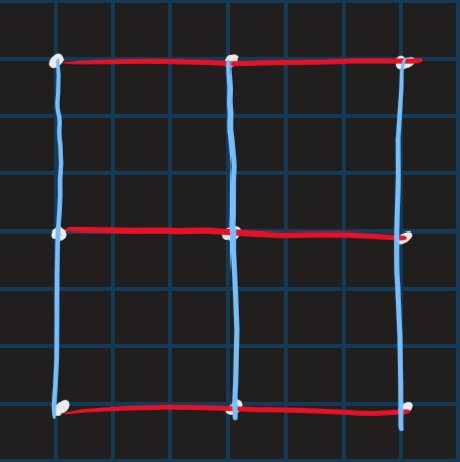
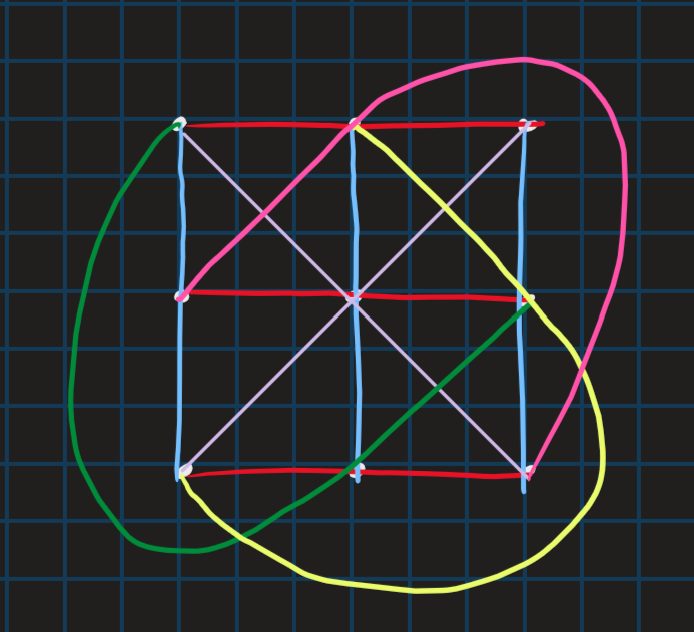
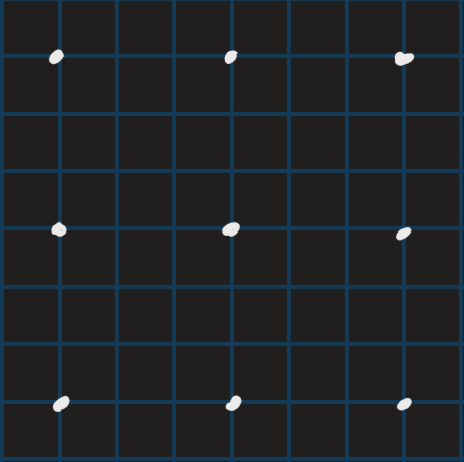
To visualize this geometry, we first place 9 points in a \(3\times 3\) grid.
Next, draw 3 horizontal and 3 vertical lines like so to satisfy axiom 3.
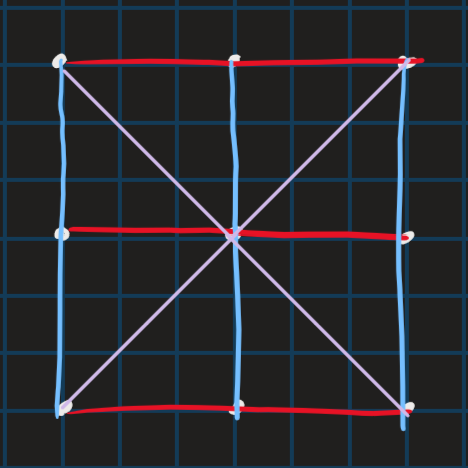
Since we need to connect the corners to satisfy axiom 2, draw two diagonal lines.
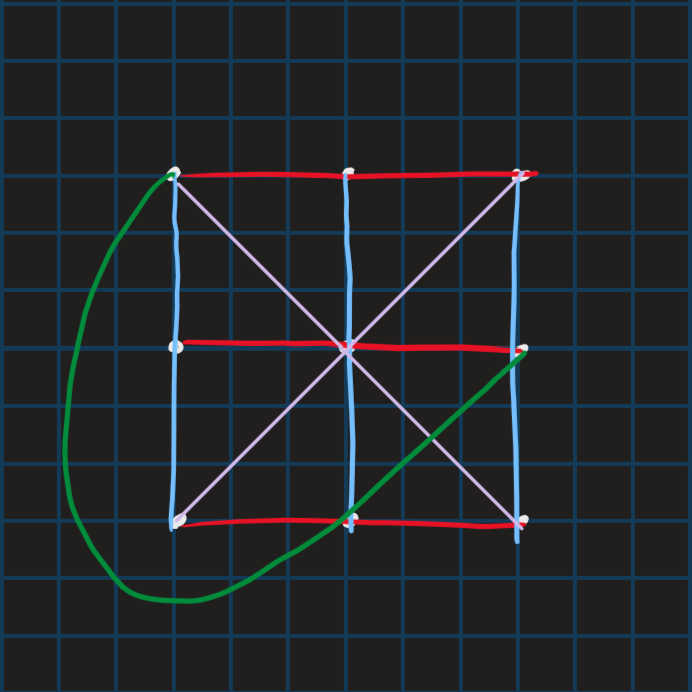
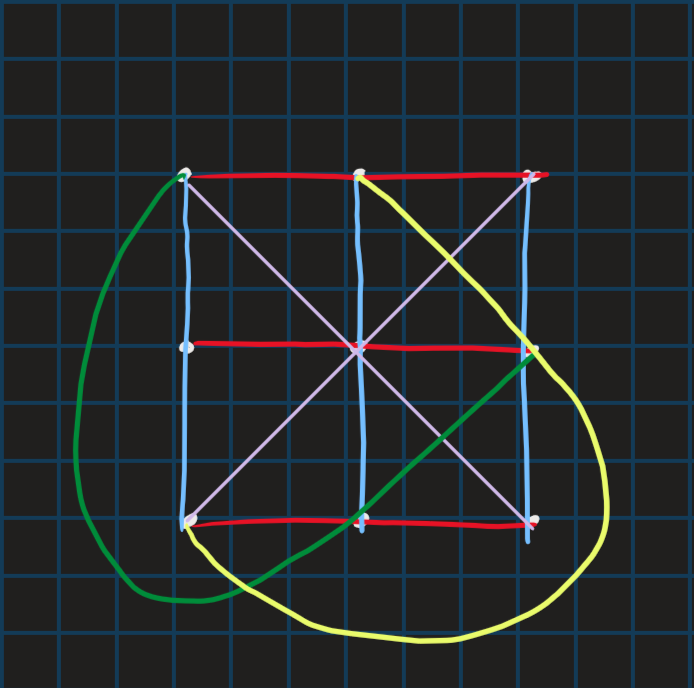
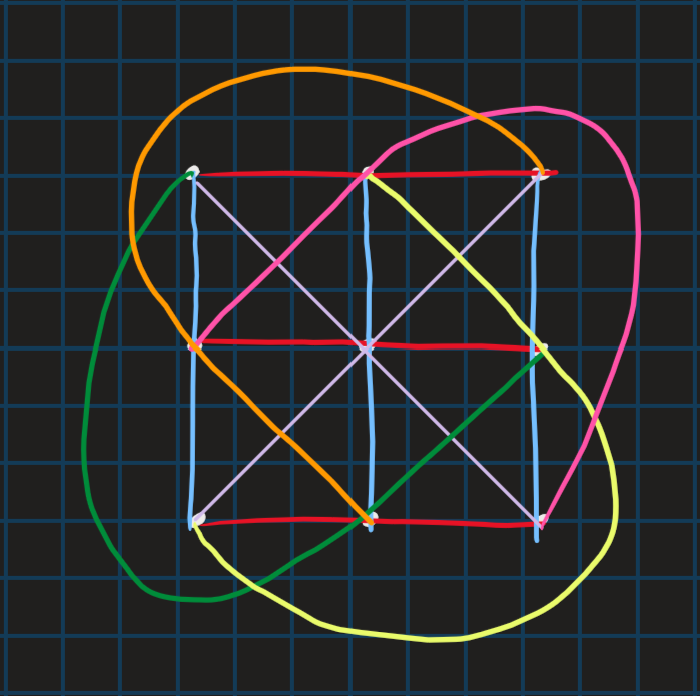
But, the corners do not connect to the middle edges on the opposing sides. Notice that each corner is not adjacent to exactly two edges. So, we can draw lines that connect each corner to their nonadjacent edge points that will conveniently satisfy axioms 2 and 3.
Now, all axioms are satisfied. There are 12 lines in this depiction of the Nine Point Geometry.

Checkpoint 1.4.7.

Modify the axioms of the Nine Point Geometry to be complete and consistent and so that they result in the same number of points and lines.