Contents
Search Book
Search Results:
No results.
Read aloud
Readability settings Prev Up Next
\(\newcommand{\R}{\mathbb{R}}
\newcommand{\Z}{\mathbb{Z}}
\newcommand{\lt}{<}
\newcommand{\gt}{>}
\newcommand{\amp}{&}
\definecolor{fillinmathshade}{gray}{0.9}
\newcommand{\fillinmath}[1]{\mathchoice{\colorbox{fillinmathshade}{$\displaystyle \phantom{\,#1\,}$}}{\colorbox{fillinmathshade}{$\textstyle \phantom{\,#1\,}$}}{\colorbox{fillinmathshade}{$\scriptstyle \phantom{\,#1\,}$}}{\colorbox{fillinmathshade}{$\scriptscriptstyle\phantom{\,#1\,}$}}}
\)
Section 1.3 Discovering More Limits
For some applications we need specialized limits. The next activity illustrates how to modify the first definition to handle these cases.
Like the previous activity about limits consider
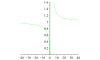
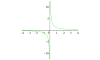
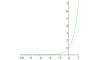
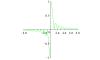
FigureΒ 1.3.1 which shows examples of limits to infinity (or negative infinity) that are defined, and
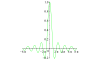
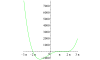
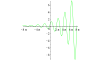
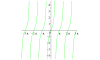
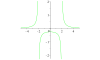
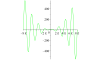
FigureΒ 1.3.2 which shows examples of limits to infinity (or negative infinity) that are not defined.
\begin{equation*}
\lim_{t \to \infty} f(t)
\end{equation*}
\begin{equation*}
\lim_{y \to \infty} g(y)
\end{equation*}
\begin{equation*}
\lim_{x \to \infty} h(x)
\end{equation*}
\begin{equation*}
\lim_{t \to -\infty} f(t)
\end{equation*}
\begin{equation*}
\lim_{y \to -\infty} g(y)
\end{equation*}
\begin{equation*}
\lim_{x \to -\infty} h(x)
\end{equation*}
\begin{equation*}
\lim_{t \to \infty} f(t)
\end{equation*}
\begin{equation*}
\lim_{y \to \infty} g(y)
\end{equation*}
\begin{equation*}
\lim_{y \to -\infty} g(y)
\end{equation*}
Diagram Exploration Keyboard Controls
Key
Action
Enter, A
Activate keyboard driven exploration
B
Activate menu driven exploration
Escape
Leave exploration mode
Cursor down
Explore next lower level
Cursor up
Explore next upper level
Cursor right
Explore next element on level
Cursor left
Explore previous element on level
X
Toggle expert mode
W
Extra details if available
Space
Repeat speech
M
Activate step magnification
Comma
Activate direct magnification
N
Deactivate magnification
Z
Toggle subtitles
C
Cycle contrast settings
T
Monochrome colours
L
Toggle language (if available)
K
Kill current sound
Y
Stop sound output
O
Start and stop sonification
P
Repeat sonification output
Figure 1.3.1. Each of these limits are defined.
\begin{equation*}
\lim_{x \to \infty} h(x)
\end{equation*}
\begin{equation*}
\lim_{\alpha \to \infty} h(\alpha)
\end{equation*}
\begin{equation*}
\lim_{\alpha \to -\infty} h(\alpha)
\end{equation*}
Diagram Exploration Keyboard Controls
Key
Action
Enter, A
Activate keyboard driven exploration
B
Activate menu driven exploration
Escape
Leave exploration mode
Cursor down
Explore next lower level
Cursor up
Explore next upper level
Cursor right
Explore next element on level
Cursor left
Explore previous element on level
X
Toggle expert mode
W
Extra details if available
Space
Repeat speech
M
Activate step magnification
Comma
Activate direct magnification
N
Deactivate magnification
Z
Toggle subtitles
C
Cycle contrast settings
T
Monochrome colours
L
Toggle language (if available)
K
Kill current sound
Y
Stop sound output
O
Start and stop sonification
P
Repeat sonification output
Figure 1.3.2. None of these limits are defined.
Activity 1.3.3 . Describe Definining Traits of More Limits.
The goal of this activity is to determine traits of functions where a limit to infinity (or negative infinity) is defined by considering their graphs and to characterize conditions when the limit is not defined.
(a)
For each limit given in
FigureΒ 1.3.4 determine if the limit is defined or not by finding a matching example in
FigureΒ 1.3.1 for limits that are defined or in
FigureΒ 1.3.2 for limits that are not defined.
(b)
Using the examples in
FigureΒ 1.3.1 ,
FigureΒ 1.3.2 , and
FigureΒ 1.3.4 find traits of the graphs when the limit to infinity (or negative infinity) is defined that are not present in the graphs when the limit to infinity (or negative infinity) is not defined. Likewise find traits of the graphs when the limit to infinity (or negative infinity) is not defined that are not present in the graphs when the limit to infinity (or negative infinity) is defined.
\begin{equation*}
\lim_{x \to \infty} f(x)
\end{equation*}
\begin{equation*}
\lim_{y \to \infty} g(y)
\end{equation*}
\begin{equation*}
\lim_{z \to \infty} h(z)
\end{equation*}
\begin{equation*}
\lim_{x \to -\infty} f(x)
\end{equation*}
\begin{equation*}
\lim_{y \to -\infty} g(y)
\end{equation*}
\begin{equation*}
\lim_{z \to -\infty} h(z)
\end{equation*}
Diagram Exploration Keyboard Controls
Key
Action
Enter, A
Activate keyboard driven exploration
B
Activate menu driven exploration
Escape
Leave exploration mode
Cursor down
Explore next lower level
Cursor up
Explore next upper level
Cursor right
Explore next element on level
Cursor left
Explore previous element on level
X
Toggle expert mode
W
Extra details if available
Space
Repeat speech
M
Activate step magnification
Comma
Activate direct magnification
N
Deactivate magnification
Z
Toggle subtitles
C
Cycle contrast settings
T
Monochrome colours
L
Toggle language (if available)
K
Kill current sound
Y
Stop sound output
O
Start and stop sonification
P
Repeat sonification output
Figure 1.3.4. Determine which of these limits is defined.
Checkpoint 1.3.5 .
Limits to infinity and to negative infinity require their own definitions.
What parts of the definition need to change?
To what do those parts change?
If we treat two limits as distinct because they have different definitions, how many distinct types of limits have we defined?