Section 1.8 Discovering Continuity

Continuity is the next property of curves that make them nice. Like with limits continuity is defined at a point and we say the function is continuous on an interval if the function is continuous at each point in that interval.
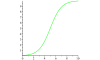
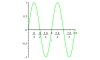
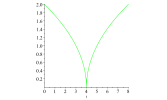
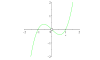
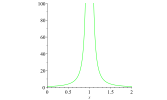
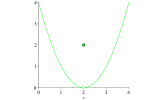
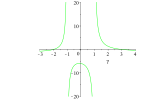
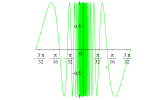
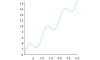
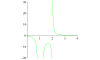
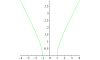
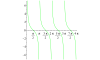
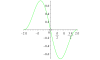
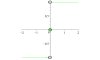
Our first step in understanding continuity is to consider the examples in FigureΒ 1.8.1 which shows examples of points on curves where the function is continuous, and FigureΒ 1.8.2 which shows examples of points on curves where the function is discontinuous.
all points
all points
all points
\([-2,0) \cup (0,2]\)
\([0,1) \cup (1,2]\)
\([0,2) \cup (2,4]\)
\([-3,-1) \cup (-1,1) \cup (1,3]\)
\((0,1) \cup (1,2) \cup \ldots \)
\((-\infty,0) \cup (0,\infty)\)
Diagram Exploration Keyboard Controls
Key Action
Enter, A Activate keyboard driven exploration
B Activate menu driven exploration
Escape Leave exploration mode
Cursor down Explore next lower level
Cursor up Explore next upper level
Cursor right Explore next element on level
Cursor left Explore previous element on level
X Toggle expert mode
W Extra details if available
Space Repeat speech
M Activate step magnification
Comma Activate direct magnification
N Deactivate magnification
Z Toggle subtitles
C Cycle contrast settings
T Monochrome colours
L Toggle language (if available)
K Kill current sound
Y Stop sound output
O Start and stop sonification
P Repeat sonification output
Figure 1.8.1. The functions are continuous at the given points (on the given intervals).
\(x=0\)
\(x=1\)
\(x=2\)
\(x \in \{ -1, 1\}\)
\(x \in \{ 0, 1, 2, 3, \ldots \}\)
\(x=0\)
Diagram Exploration Keyboard Controls
Key Action
Enter, A Activate keyboard driven exploration
B Activate menu driven exploration
Escape Leave exploration mode
Cursor down Explore next lower level
Cursor up Explore next upper level
Cursor right Explore next element on level
Cursor left Explore previous element on level
X Toggle expert mode
W Extra details if available
Space Repeat speech
M Activate step magnification
Comma Activate direct magnification
N Deactivate magnification
Z Toggle subtitles
C Cycle contrast settings
T Monochrome colours
L Toggle language (if available)
K Kill current sound
Y Stop sound output
O Start and stop sonification
P Repeat sonification output
Figure 1.8.2. The functions are discontinuous at the given points.

Activity 1.8.3. Describe Definining Traits of Continuity.

The goal of this activity is to determine traits of functions where they are continuous.

(c)

Can the limit be defined at a point that is discontinuous?
Diagram Exploration Keyboard Controls
Key Action
Enter, A Activate keyboard driven exploration
B Activate menu driven exploration
Escape Leave exploration mode
Cursor down Explore next lower level
Cursor up Explore next upper level
Cursor right Explore next element on level
Cursor left Explore previous element on level
X Toggle expert mode
W Extra details if available
Space Repeat speech
M Activate step magnification
Comma Activate direct magnification
N Deactivate magnification
Z Toggle subtitles
C Cycle contrast settings
T Monochrome colours
L Toggle language (if available)
K Kill current sound
Y Stop sound output
O Start and stop sonification
P Repeat sonification output
Figure 1.8.4. Determine where these are continuous.

Activity 1.8.5. Common description of continuity.

(c)

Draw a function that has a different type of discontinuity on \([0,3]\)

(d)

What do these experiments hint is true about drawing continuous functions.

(e)

Review the Cantor function (day 1 materials). How does this compare to your guess above?

Checkpoint 1.8.6. Intervals of discontinuity.

From the examples above it may appear the discontinuities occur solely at a single point or on an interval where the function is undefined. However, there exists functions that are discontinuous on an interval where they are defined.
\begin{equation*} \text{sp}(x) = \begin{cases} 0 \amp \text{ if } x \text{ is irrational} \\ 1 \amp \text{ if } x \text{ is rational} \end{cases} \end{equation*}
\begin{equation*} \text{confetti}(x) = \begin{cases} 1 \amp \text{ if } x \text{ is irrational} \\ \frac{1}{p} \amp \text{ if } x=\frac{n}{p^k} n,k \in \Z^+, p \text{ is prime} \\ 0 \amp \text{ otherwise} \end{cases} \end{equation*}
Show that the salt and pepper (\(sp(x)\)) function is discontinuous everywhere.
Note, the confetti function is also discontinuous everywhere.