Section 1.1 Section Title

Text of section.
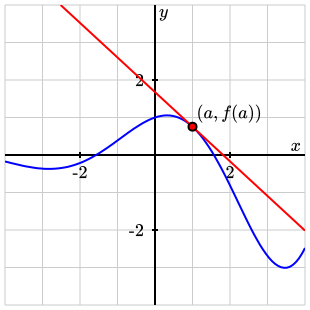
Figure 1.1.1. Solution to a differential equation
Diagram Exploration Keyboard Controls
Key Action
Enter, A Activate keyboard driven exploration
B Activate menu driven exploration
Escape Leave exploration mode
Cursor down Explore next lower level
Cursor up Explore next upper level
Cursor right Explore next element on level
Cursor left Explore previous element on level
X Toggle expert mode
W Extra details if available
Space Repeat speech
M Activate step magnification
Comma Activate direct magnification
N Deactivate magnification
Z Toggle subtitles
C Cycle contrast settings
T Monochrome colours
L Toggle language (if available)
K Kill current sound
Y Stop sound output
O Start and stop sonification
P Repeat sonification output
Figure 1.1.2. Limit example

Checkpoint 1.1.3.

Evaluate the definite integral \(\int_{0}^{\pi/3} \sin^{27} \theta \cos \theta \, d\theta\text{.}\)
Solution.
Let \(u = \sin \theta\text{,}\) then \(du = \cos \theta \, d\theta\text{.}\) The limits of integration change as follows:
  • When \(\theta = 0\text{,}\) \(u = \sin(0) = 0\text{.}\)
  • When \(\theta = \pi/3\text{,}\) \(u = \sin(\pi/3) = \sqrt{3}/2\text{.}\)
\begin{align*} \int_{0}^{\sqrt{3}/2} u^{27} \, du \amp = \left. \frac{u^{28}}{28} \right|_{0}^{\sqrt{3}/2}\\ \amp = \frac{(\sqrt{3}/2)^{28}}{28} - \frac{0^{28}}{28}\\ \amp = \frac{3^{14}}{28 \cdot 2^{28}} \end{align*}

Checkpoint 1.1.4.

For the function \(f(x,y) = x^2 + xy + y^2\text{,}\) find the gradient vector \(\nabla f(1,3)\text{.}\)
Solution.
First, we find the partial derivatives:
\begin{align*} f_x \amp = 2x + y\\ f_y \amp = x + 2y \end{align*}
So, \(\nabla f(x,y) = \langle 2x + y, x + 2y \rangle\text{.}\)
Evaluating at the point \((1,3)\text{:}\)
\begin{equation*} \nabla f(1,3) = \langle 2(1) + 3, 1 + 2(3) \rangle = \langle 5, 7 \rangle \end{equation*}

Checkpoint 1.1.5.

Evaluate the double integral \(\int_{0}^{1} \int_{0}^{2-2y} (3xy - x^2 - y^2 + 6) \, dx \, dy\text{.}\)
Solution.
Integrating with respect to \(x\) first:
\begin{align*} \int_{0}^{1} \int_{0}^{2-2y} (3xy - x^2 - y^2 + 6) \, dx \, dy \amp = \int_{0}^{1} \left[ \frac{3}{2}x^2y - \frac{x^3}{3} - xy^2 + 6x \right]_{0}^{2-2y} \, dy\\ \amp = \int_{0}^{1} \left( \frac{32}{3}y^3 - 22y^2 + 2y + \frac{28}{3} \right) \, dy\\ \amp = \left[ \frac{8}{3}y^4 - \frac{22}{3}y^3 + y^2 + \frac{28}{3}y \right]_{0}^{1}\\ \amp = \frac{8}{3} - \frac{22}{3} + 1 + \frac{28}{3} = \frac{17}{3} \end{align*}
